the noodle atlas
8 noodles, 8 cities, one map
i have eaten all eight. some twice in one day.
- rough rule: the north eats wheat noodles (pulled, ripped, cut), the south eats rice noodles. the line runs roughly along the qinling mountains and huai river.
- lanzhou beef noodles are pulled to order by hui muslim cooks and judged on a five-color standard: clear broth, white radish, red chili oil, green herbs, yellow noodles.
- the biang in biangbiang noodles is one of the most complex chinese characters in use: the common traditional form is usually counted at 58 strokes.
- dan dan noodles are named after the shoulder pole street vendors carried them on. in sichuan it's a snack bowl, not a meal.
- most bowls here cost about $1–5. order by weight: 二两 (èr liǎng) is a normal portion.
china doesn’t have “noodles.” it has hundreds of noodle traditions, and every city will tell you, with total confidence, that theirs is the real one. you can eat a different noodle for breakfast in every province and still not run out.
this is the atlas: eight regional noodles, pinned to where they come from, with the history, the first bite, and exactly what to say at the counter. tap a pin, read the card, then go eat it.
the map: 8 regional noodles across china
lanzhou beef noodles
兰州牛肉面 · lánzhōu niúròu miàn · from lanzhou, gansu · soupy
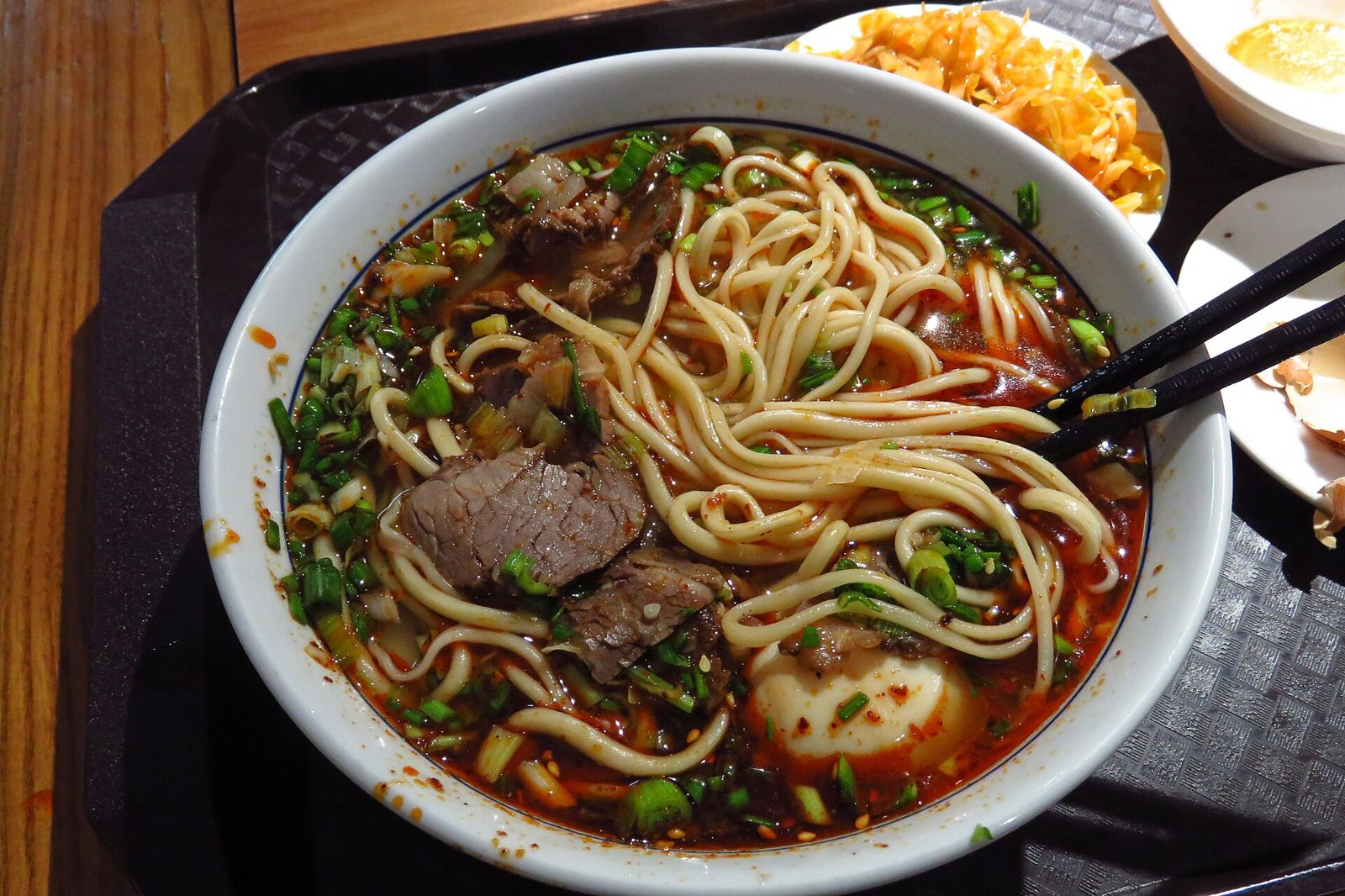
hand-pulled wheat noodles in a clear beef broth, topped with sliced beef, white radish, chili oil, cilantro and garlic sprouts. pulled to order, in front of you, in about a minute.
“the broth hits first: beefy, peppery, almost floral from the spice bag, with a slow chili warmth from the red oil. then the noodles, springy and slightly alkaline, with a real bite to them.”
the storylocals credit ma baozi, a hui muslim cook who started selling it in lanzhou in 1915, with fixing the modern formula. the hui (chinese-speaking muslims) still run most of the shops, which is why the beef is halal and you'll never find pork on the menu. the bowl is judged by a five-color standard: one clear (broth), two white (radish), three red (chili oil), four green (cilantro and garlic sprouts), five yellow (the noodles).
how to eat itpick your thickness at the counter (二细 èr xì, "second-thin", is the classic all-rounder; 韭叶 jiǔyè is flat like a chive leaf). sip the broth before the chili oil sinks in, then slurp. locals often add a side of sliced beef or a marinated egg.
biangbiang noodles
biángbiáng面 · biángbiáng miàn · from xi'an, shaanxi · chewy
belt-wide hand-ripped wheat noodles, sometimes one single noodle per bowl, tossed with chili flakes, garlic and scallion that get flash-sizzled with smoking hot oil. often topped with braised pork, tomato-egg, or both.
“chewy, almost bouncy, with that toasty, garlicky fried-chili smell from the hot-oil pour. one noodle is a whole mouthful.”
the storythe name is (probably) the sound of the dough slapping the counter as it's stretched. the character for biáng is famously absurd: the most common traditional form runs to 58 strokes (sources quote anywhere from the 40s to the high 50s), packed with horses, knives, a moon and a heart, and it wasn't even in unicode until 2020. shaanxi kids learn a rhyme to remember how to write it.
how to eat ittoss everything thoroughly before your first bite so the chili oil coats every fold. don't try to be dainty: bite the noodle off, it's meant to be a mess. a splash of black vinegar from the table is very shaanxi.
dan dan noodles
担担面 · dàndàn miàn · from chengdu, sichuan · saucy
a small bowl of thin wheat noodles over a sauce of chili oil, sichuan pepper, soy and preserved mustard greens (芽菜), crowned with crispy fried minced pork. in sichuan it's a snack-size bowl, not a meal.
“salty-savory first, then the slow buzz of sichuan pepper (that tingly 麻 má) creeping across your lips while the chili oil warms the back of your throat.”
the storythe name comes from the 扁担 (biǎndan), the bamboo shoulder pole street hawkers used to carry a stove on one end and noodles and sauce on the other. the popular story credits a zigong vendor nicknamed chen baobao in 1841, though like most dish origin stories it's more lore than record. the peanut-butter-heavy versions you see abroad are a later remix, not the sichuan original.
how to eat itthe sauce is hiding at the bottom. stir from the bottom up until every strand is red and glossy, then eat it fast before the noodles soak it all up.
chongqing xiaomian
重庆小面 · chóngqìng xiǎomiàn · from chongqing · saucy
chongqing's breakfast: thin alkaline wheat noodles in a fierce mix of chili oil, sichuan pepper, garlic water, soy, pickles and crushed peanuts, with a few leafy greens. "small noodles" because the basic version is just noodles and sauce, no meat.
“pure heat and numbness, fast. then garlic, then the crunch of peanuts, then you're sweating at 8am and somehow loving it.”
the storyxiaomian is a street-food tradition rather than one inventor's dish: the city has thousands of tiny stalls, and every one guards its own blend of a dozen-plus seasonings. add-ons like 豌杂 (wān zá, mushy peas and minced pork) or braised beef turn it into a heartier bowl.
how to eat itorder by weight: 二两 (èr liǎng, about 100g of dry noodles) is a normal bowl. say 微辣 if you're not from chongqing. eat it on a plastic stool on the sidewalk, that's the move.
zhajiangmian
炸酱面 · zhájiàngmiàn · from beijing · saucy
thick hand-cut wheat noodles with a dark, salty sauce of fermented soybean paste fried with diced pork belly, served with a little rainbow of crunchy toppings: cucumber, radish, bean sprouts, soybeans, celery.
“deeply salty and savory, almost like a meaty miso, cut by cold crisp cucumber and the sweet crunch of radish.”
the storythe "fried sauce noodle" is shared across northern china (shandong has a strong claim to its roots), but old beijing made it a ritual, with the toppings called 菜码 (càimǎ) laid out in tiny dishes. it also crossed the sea: korea's jjajangmyeon descends from it via chinese migrants, mostly from shandong.
how to eat itdump all the little topping dishes in, spoon the sauce on (not all of it, it's strong), and stir hard. a raw garlic clove on the side is the old-beijing flex.
scallion oil noodles
葱油拌面 · cōngyóu bànmiàn · from shanghai · saucy
thin wheat noodles tossed in scallion oil and a sweet dark soy sauce, topped with a tangle of scallions fried until they're almost black. no meat, no broth, three ingredients, perfect.
“sweet, salty, smoky-caramelized onion flavor, glossy noodles. it tastes way more complicated than three ingredients should.”
the storya shanghainese home-cooking and noodle-shop classic, built on the city's love of sweet-savory soy (the same palate behind red-braised pork). it's the noodle shanghai grandmas make when there's "nothing" in the fridge.
how to eat ittoss it right away while it's hot so the oil coats everything. locals pair it with a bowl of wonton soup or a fried pork chop (大排) on the side.
guilin rice noodles
桂林米粉 · guìlín mǐfěn · from guilin, guangxi · slippery
round, slippery rice noodles topped with braised meats, crispy pork, fried peanuts, pickled beans and chili, dressed with a splash of rich 卤水 (lǔshuǐ, the house master-braise). you finish it at a self-serve topping bar.
“silky, soft-chewy noodles, then salty-sweet braise, crunchy peanuts and the sourness of pickled beans. it's a texture party.”
the storylocal legend says it began over 2,000 years ago, when qin dynasty soldiers from the wheat-eating north were sent south to build the lingqu canal, and cooks turned rice into noodles to remind them of home. it's a lovely story with zero documentation. what is real: every shop's lushui recipe is a closely guarded secret.
how to eat itthe default is 卤菜粉 (lǔcài fěn), the "dry" version with braise sauce. toss, eat half, then ladle in free bone broth from the pot by the door to turn the rest into soup. load up at the pickle bar.
hot dry noodles
热干面 · règānmiàn · from wuhan, hubei · dry
pre-cooked, oiled alkaline noodles flash-reheated in boiling water, then tossed dry with a thick sesame paste, soy, pickled radish, chili and scallions. no soup at all.
“thick, nutty sesame, then salty soy and a little tang from the pickles. it's heavy, warm and weirdly addictive. you will need a drink.”
the storythe popular story points to a 1930s hankou hawker named li bao, who tossed leftover cooked noodles in sesame oil so they wouldn't spoil in the summer heat, then reheated them the next morning. versions of the tale differ, but it became the anchor of wuhan's 过早 (guòzǎo), the city's competitive street-breakfast culture.
how to eat itstir it fast and thoroughly, the sesame paste clumps if you let it sit. pair it with soy milk or the local 蛋酒 (egg rice wine) to wash it down.
notice the shape of it. the pins in the north and northwest are all wheat. the pin way down in guilin is rice. that’s not an accident.
wheat in the north, rice in the south
the oldest food divide in china runs roughly along the qinling mountains and the huai river. north of that line it’s dry and cold, and wheat and millet grow well. south of it, it’s wet and warm, and rice paddies take over.
so the north became a noodle-and-dumpling culture built on flour: pulled, ripped, cut, rolled. (the dumpling half of that story is the chinese dumpling family tree.) the south mostly ate rice as rice, and when it made noodles, it made them from rice too: slippery, soft, often served in broth or with pickles. guilin mifen, guangxi’s river-snail luosifen, yunnan’s crossing-the-bridge noodles, cantonese ho fun: all rice.
it’s a generalization, and sichuan and chongqing break it happily (they’re south of the line and eat a ton of wheat noodles). but as a first map of china’s noodles, it holds up surprisingly well. if you want the bigger picture of regional cooking, the chinese food guide breaks it down city by city.
how hand-pulled noodles actually work
lamian (拉面, “pulled noodle”) is one of the best food shows on earth, and it’s free with your $3 bowl.
the dough is just wheat flour, water and salt, plus an alkaline agent. traditionally that was 蓬灰 (pénghuī), an ash made from burning a desert plant; today it’s often a commercial alkaline solution. the alkali changes the gluten so the dough can stretch insanely far without snapping, and it gives the noodles their slightly yellow color and springy bite.
then the cook rolls a log of dough, grabs both ends, and swings and twists it until the gluten lines up. then the folding starts. stretch, fold in half, stretch again. every fold doubles the strands: two, four, eight, sixteen… by the seventh or eighth fold you’ve got 128 or 256 strands, and the thinnest grade is close to thread. the whole thing takes about a minute, and the noodles go straight into the pot.
lanzhou beef noodles: the hui muslim bowl that conquered china
lanzhou sits on the yellow river in gansu, an old silk road junction with a large hui community: chinese-speaking muslims whose ancestors include persian, arab and central asian traders who settled along those routes. the noodle is theirs. that’s why every proper shop is halal, why you’ll see arabic script or a “清真” (qīngzhēn, halal) sign over the door, and why pork never shows up.
historians usually credit ma baozi, a hui cook who started selling beef noodles in lanzhou in 1915, with setting the modern form. the standard is a rhyme every lanzhou person knows:
| what it means | ||
|---|---|---|
| 一清 | one clear | the broth, clear and fragrant |
| 二白 | two white | slices of white radish |
| 三红 | three red | chili oil |
| 四绿 | four green | cilantro and garlic sprouts |
| 五黄 | five yellow | the noodles, glossy and pale yellow |
in lanzhou it’s a breakfast food. people eat it from about 7am, and the famous shops often wind down by early afternoon. outside gansu, the green-and-white “兰州拉面” signs you see on every street in china are an empire of their own, many run by hui families from neighboring qinghai. different broth, same pulling skills, still a great cheap lunch.
biangbiang noodles and the 58-stroke character
xi’an’s biangbiang noodles are the opposite of lanzhou’s: fewer, fatter, louder. each noodle is a belt, often 3–5cm wide, ripped by hand and slapped against the counter (supposedly the “biang” sound) before it hits the pot. then chili flakes, garlic and scallion go on top, and the cook pours smoking oil over them. that sizzle is the smell of shaanxi.
the character is the part everyone talks about. biáng is written with a monster of a glyph: 穴 (cave) on top, 言 (speech) in the middle flanked by 幺 (tiny) and 長 (long), a 馬 (horse) in the center, then 月 (moon), 心 (heart) and 刂 (knife), all wrapped in 辶 (walking). the most widely cited traditional form has 58 strokes and the simplified one has 42, though you’ll find counts from the 40s to the high 50s depending on the version. it isn’t in standard dictionaries, and it wasn’t added to unicode until 2020, which is why most menus print it as a painted sign or just write “biangbiang” in latin letters.
in xi’an, have it with a terracotta warriors day. it’s the right fuel for the walk.
dan dan noodles: named after a shoulder pole
dan dan noodles take their name from the 扁担 (biǎndan), the bamboo pole sichuan street vendors balanced on one shoulder, a little stove and noodles hanging from one end and the sauce pots from the other. they’d walk the lanes calling out, and you’d buy a small bowl right there on the street.
the usual origin story says a zigong hawker nicknamed chen baobao started it in 1841. treat that date as lore, not record. what matters more: in chengdu dan dan noodles are a small, dry-ish snack bowl with chili oil, sichuan pepper, preserved mustard greens and crispy pork, eaten as a side next to wontons. the creamy peanut-sauce versions in western restaurants are a different, later thing.
chongqing xiaomian: breakfast that fights back
chongqing eats xiaomian for breakfast, in staggering numbers, on plastic stools. “small noodle” just means the base version has no meat: noodles, greens, and a sauce of a dozen or more seasonings, every stall’s blend slightly different. it is, no cap, the spiciest thing on this map. say 微辣 (wēi là, mild) the first time. you will still sweat.
zhajiangmian, scallion oil noodles and hot dry noodles: the sauce-and-toss crew
three cities, three no-broth noodles:
- beijing’s zhajiangmian is all about the salty fermented soybean sauce and the little dishes of crunchy vegetables. it’s the go-to bowl after a long day in the hutongs.
- shanghai’s scallion oil noodles are three ingredients (noodles, sweet soy, scallions fried until nearly black) and somehow perfect. find them in old noodle shops around shanghai.
- wuhan’s hot dry noodles are pre-cooked, oiled noodles reheated in seconds and tossed with thick sesame paste. they power the city’s 过早 (guòzǎo) street-breakfast culture.
guilin mifen: the rice noodle with a legend
the southernmost pin is guilin, and the only rice noodle here. local legend says qin dynasty soldiers sent south to build the lingqu canal, over 2,000 years ago, missed their northern wheat noodles, so cooks pressed rice into noodles for them. it’s a great story and there’s no evidence for it. what you can check yourself: breakfast in guilin or yangshuo is a $1–2 bowl of braised-meat noodles, a free pickle bar, and a pot of bone broth by the door for refills.
brandon here: i walked into a guilin mifen shop at 7am, pointed at what the guy in front of me had, and ate the best $1.50 breakfast of my life. then i went back for broth. twice. nobody minded.
how to order noodles in china without stress
- order by weight. 一两 (yì liǎng) is small, 二两 (èr liǎng) is normal, 三两 is hungry. one liang is 50g of dry noodles.
- pay first. lots of noodle shops have you order and pay at the counter or by scanning a qr code. set up alipay before you go.
- spice words: 不辣 (bù là, not spicy), 微辣 (wēi là, mild), 中辣 (zhōng là, medium). don’t order 特辣 to prove a point.
- slurping is fine. so is lifting the bowl to drink the broth.
if you’d rather have a local walk you through the noodle stalls (especially in chengdu or xi’an), a food tour is genuinely worth it for night one.
the vibe check
china’s noodle map is basically its geography and history on a plate: wheat where it’s dry, rice where it’s wet, a muslim silk road town that taught a whole country to love beef broth, and street vendors who named a dish after the stick on their shoulder. eat the noodle the city is famous for, eat it early, eat it where the locals are queuing, and you’ll leave knowing china better than any museum could teach you. ok maybe tie with the museum. but the noodles are $3.
the kit for this trip
heads up: some links above are affiliate links. if you book through them we earn a small commission at no extra cost to you — it keeps this guide free. more on that.