banquet etiquette
a round table is a map of who's who
if in doubt, sit where you're pointed. always.
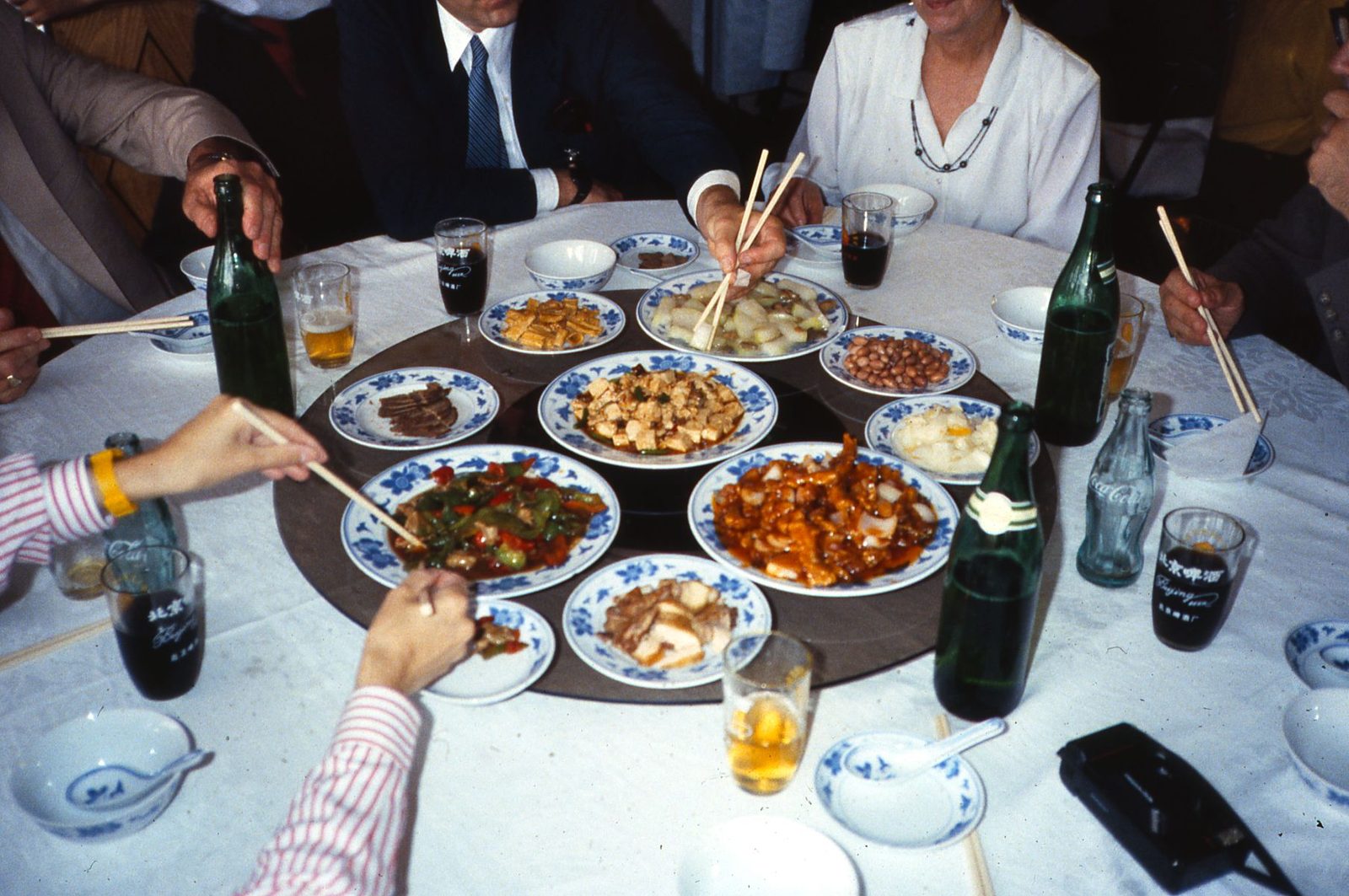
- the seat facing the door is the main seat — the host's (or the eldest's). the guest of honor usually sits on the host's right. don't pick your own chair; wait to be pointed.
- toasting: hold your glass lower than an elder's or your host's when you clink. 'ganbei' means empty it. you can decline baijiu politely with tea — 'yi cha dai jiu'.
- never stand chopsticks upright in rice (it looks like funeral incense), don't point with them, don't tap your bowl.
- turn the lazy susan slowly, clockwise by default, and never while someone is mid-scoop. tap two fingers to say thanks when someone pours your tea.
a chinese banquet looks like chaos — ten people, fourteen dishes, a spinning glass disk, someone yelling “ganbei” every four minutes. it is actually one of the most choreographed meals on earth. where you sit, who toasts first, how low you hold your glass: all of it quietly says who matters to whom.
the good news: nobody expects a foreigner to know all of it. knowing some of it, though, makes people visibly delighted. here’s the cheat sheet, starting with the chairs.
where to sit at a chinese banquet
the host (主陪 zhǔpéi) — the main seat
deepest in the room, facing the door: you can see everyone who walks in and nobody can come up behind you. the person paying and running the night sits here, opens the first toast, and sets the pace. at a family dinner this is usually the eldest, not whoever is paying. some regions and some hosts flip it and put the guest of honor in this seat as the ultimate compliment.
second guest (二宾 èrbīn)
on the host's left: the second-most-honored guest. the host can turn either way and talk to both of the people who matter most.
the host's third (三陪 sānpéi)
someone from the host's side — a colleague, cousin, younger partner. their job is to keep the second guest's glass and plate full and the conversation going on this side of the table.
fourth guest (四宾 sìbīn) or a junior guest
mid-table, further from the head. guests and hosts alternate around the ring on purpose, so no guest ever ends up stranded next to only their own people.
third guest (三宾 sānbīn) — on the deputy's right
the deputy's side mirrors the host's: the deputy's right hand is the next-ranked guest, so the far half of the table has its own little head.
the deputy host (副陪 fùpéi) — back to the door
directly opposite the host. the deputy toasts after the host (so the host can pace themselves), refills glasses, talks to the waiters since this seat is nearest the serving door, and often quietly settles the bill. historically the 'worst' seat for status, but in practice a power seat: whoever sits here is running the logistics of the whole night.
fourth guest (四宾 sìbīn) — on the deputy's left
the deputy's left-hand guest. near the door and the dishes coming in, so it's lower status — but very good for grabbing the first scoop of whatever just landed.
a junior person from either side
the most junior people — the youngest colleague, the driver, the assistant — sit near the door. they pour tea, pass things, and fetch the waiter. if you're a foreign guest and someone steers you here, nothing is wrong; if they steer you to seat 10, you are the main event.
the host's fourth (四陪 sìpéi)
another person from the host's side, sitting next to the guest of honor so the most important guest always has someone to top up their glass and explain the dishes.
guest of honor (主宾 zhǔbīn)
on the host's right hand: the single most important guest. the host toasts them first, serves them the best piece of fish, and turns to them all night. older ranking systems (and some guides) put the top guest on the host's left instead — the 'left vs right is more honorable' question has flipped back and forth over chinese history — so just let your host point you to your chair.
- 1the host (主陪 zhǔpéi) — the main seat
- 2second guest (二宾 èrbīn)
- 3the host's third (三陪 sānpéi)
- 4fourth guest (四宾 sìbīn) or a junior guest
- 5third guest (三宾 sānbīn) — on the deputy's right
- 6the deputy host (副陪 fùpéi) — back to the door
- 7fourth guest (四宾 sìbīn) — on the deputy's left
- 8a junior person from either side
- 9the host's fourth (四陪 sìpéi)
- 10guest of honor (主宾 zhǔbīn)
tap a seat to see who sits there and why. the short version: the main seat (主位 zhǔwèi) is the one deepest in the room, facing the door. the host sits there. the guest of honor goes on the host’s right hand, the second guest on the host’s left, and the deputy host (副陪 fùpéi) sits directly opposite, back to the door, running drinks, waiters and — very often — the bill. junior people fill in near the door.
this isn’t new. the most famous dinner in chinese history, the hongmen banquet of 206 bc, is remembered partly for its seating. sima qian’s records of the grand historian tells us who faced which way: xiang yu took the honored east-facing seat, while his rival liu bang, the future founder of the han dynasty, was put facing north, a lower seat that many historians read as a deliberate snub. then a sword dance “for entertainment” started heading toward liu bang. he slipped out “to use the toilet” and escaped. “a hongmen banquet” is still the idiom for a dinner invitation with a trap in it.
two honest caveats. first, which side is more honorable, left or right, has flipped more than once over chinese history, and some guides still rank the host’s left as the top guest seat. second, some hosts and regions put the guest of honor in the main seat as the ultimate compliment, and at family dinners it’s simply the eldest. so the real rule is: don’t sit down until someone points at a chair. they will. it’s part of the ritual.
the lazy susan: rules of the spin
the glass turntable feels ancient, but it’s surprisingly modern. one popular origin story credits a tokyo restaurant, meguro gajoen, in the early 1930s; in the us, engineer george hall redesigned it for san francisco-area chinese restaurants like johnny kan’s in the 1950s. either way, it’s now standard on banquet tables across china.
- turn it slowly, and clockwise unless the table is already going the other way.
- never spin it while someone is mid-scoop. look around first.
- when a new dish lands, it often gets turned to the guest of honor first. let it reach them.
- use the serving spoon or chopsticks if they’re provided. if not, flip your own chopsticks to the clean end for serving — some families do this, some don’t care.
how to toast at a chinese dinner
toasting is the engine of the night. the host opens with a toast to everyone, then the host and deputy go around the table, and then everyone toasts everyone. some ground rules:
- ganbei (干杯) literally means “dry the cup”. if someone says it, they mean bottoms up. suíyì (随意) means “drink as much as you like” — a sip is fine.
- clink lower. when you touch glasses with your host, an elder or a boss, hold your rim slightly below theirs. it’s a small bow in glass form. they may try to go lower than you. this can become a limbo contest. it’s adorable.
- stand up to toast someone important, and toast with both hands on the glass if you want to be extra polite.
- baijiu is the clear grain spirit, usually 40–55% alcohol, served in tiny glasses that are dangerously easy to refill. moutai is the prestige bottle at business dinners.
how to politely decline baijiu
you are allowed to not drink. the graceful lines:
- yǐ chá dài jiǔ (以茶代酒) — “let me toast with tea instead of wine.” classic, totally respectable.
- wǒ kāichē (我开车) — “i’m driving.” china’s drink-driving enforcement is strict, so this ends the conversation instantly.
- a medical reason or “i’m allergic to alcohol” also works and won’t be questioned.
say it before the first toast, smile, and raise your tea or juice every time a toast comes around. what reads as rude is accepting a few rounds and then bailing.
brandon here: at my first real banquet — a friend’s uncle’s birthday dinner in jinan, shandong — i didn’t know that “ganbei” was literal. i drank five full glasses of baijiu in about forty minutes because every person at the table wanted their own toast with the american. jules found me later explaining american football to the uncle’s business partner with a lazy susan as the diagram. the line “yi cha dai jiu” would have saved me. learn it.
chopstick taboos (the ones that actually matter)
- never stand your chopsticks upright in a bowl of rice. it looks like the incense sticks placed in a bowl at funerals and ancestor offerings (more on that side of life in what chinese people actually believe). this is the big one. rest them on the chopstick rest or across the edge of your plate.
- don’t point at people with chopsticks, or wave them around while you talk.
- don’t tap your bowl with them. it’s associated with beggars asking for food.
- don’t dig through a shared dish looking for the best piece. take what’s closest to you.
- don’t pass food chopstick-to-chopstick. it echoes the way bones are passed with chopsticks after a cremation in some traditions (this one is stronger in japan, but people in china often notice it too).
if someone serves food onto your plate with their chopsticks, that’s affection, not a hygiene violation. say thank you and eat it.
the whole fish: don’t flip it
a whole steamed fish is the centerpiece of many banquets, because yú (鱼, fish) sounds like yú (余, surplus). at new year it’s served as a wish for “surplus every year.” (the rest of the holiday food lineup is in chinese festivals through the year.)
when you’ve eaten the top half, don’t turn the fish over to get at the bottom. in coastal fishing communities especially in guangdong, fujian and hong kong, flipping the fish is said to mean flipping a boat — bad luck for anyone who makes a living on the water. instead, someone lifts out the spine and you keep going. the fish head is often pointed at the guest of honor, and in some places that means they’re owed a toast.
the bill fight
in china, the person who invited you pays. the whole bill, every time. splitting (aa zhì, “aa style”) is common among young friends but awkward at a formal dinner.
what you’ll see at the end: two or three people physically wrestling over who gets to pay, phones out (alipay and wechat pay at the ready), arms blocking arms. it’s sincere and performative — paying shows generosity and status. the pro move is to slip away “to the bathroom” mid-meal and pay at the counter before anyone notices. if you’re a guest, offer once or twice, then let them win and promise to host next time. then actually host next time.
tea tapping and leaving a little food
when someone refills your tea, tap two or three fingers on the table near your cup. in cantonese areas this is called “finger kowtow” and it means thanks without interrupting the conversation. the story everyone tells: the qianlong emperor traveled south in disguise and poured tea for his servant, who couldn’t kowtow without blowing the emperor’s cover, so he bent his fingers on the table instead. it’s a great legend and almost certainly not documented history, but the gesture is real and everyone will clock it.
when you’re done eating, leaving a few bites on your plate traditionally signals “you fed me so well i couldn’t finish,” while a spotless plate can make an anxious host order more. that said, food waste is a big topic in china right now — a nationwide “clean plate” campaign started in 2013, and an anti-food-waste law passed in 2021 — so the modern move is a bite or two, not half a plate. take leftovers home (dǎbāo, 打包). nobody minds.
for what to actually order, see our chinese food guide, and the dish-by-dish dumpling family tree.
the vibe check
a chinese banquet is less about the food than about the table: who is honored, who is looked after, who keeps everybody’s glass full. you don’t have to get it perfect. sit where you’re pointed, clink low, keep your chopsticks lying down, turn the lazy susan gently, and tap your fingers when someone pours your tea. do those five things and somebody at the table will tell you your manners are better than theirs. (they’re being polite. take the compliment anyway.)
the kit for this trip
heads up: some links above are affiliate links. if you book through them we earn a small commission at no extra cost to you — it keeps this guide free. more on that.