a week of hotpot
7 days, 7 pots, 1 humbled stomach
mild is a lie. a beautiful, delicious lie.
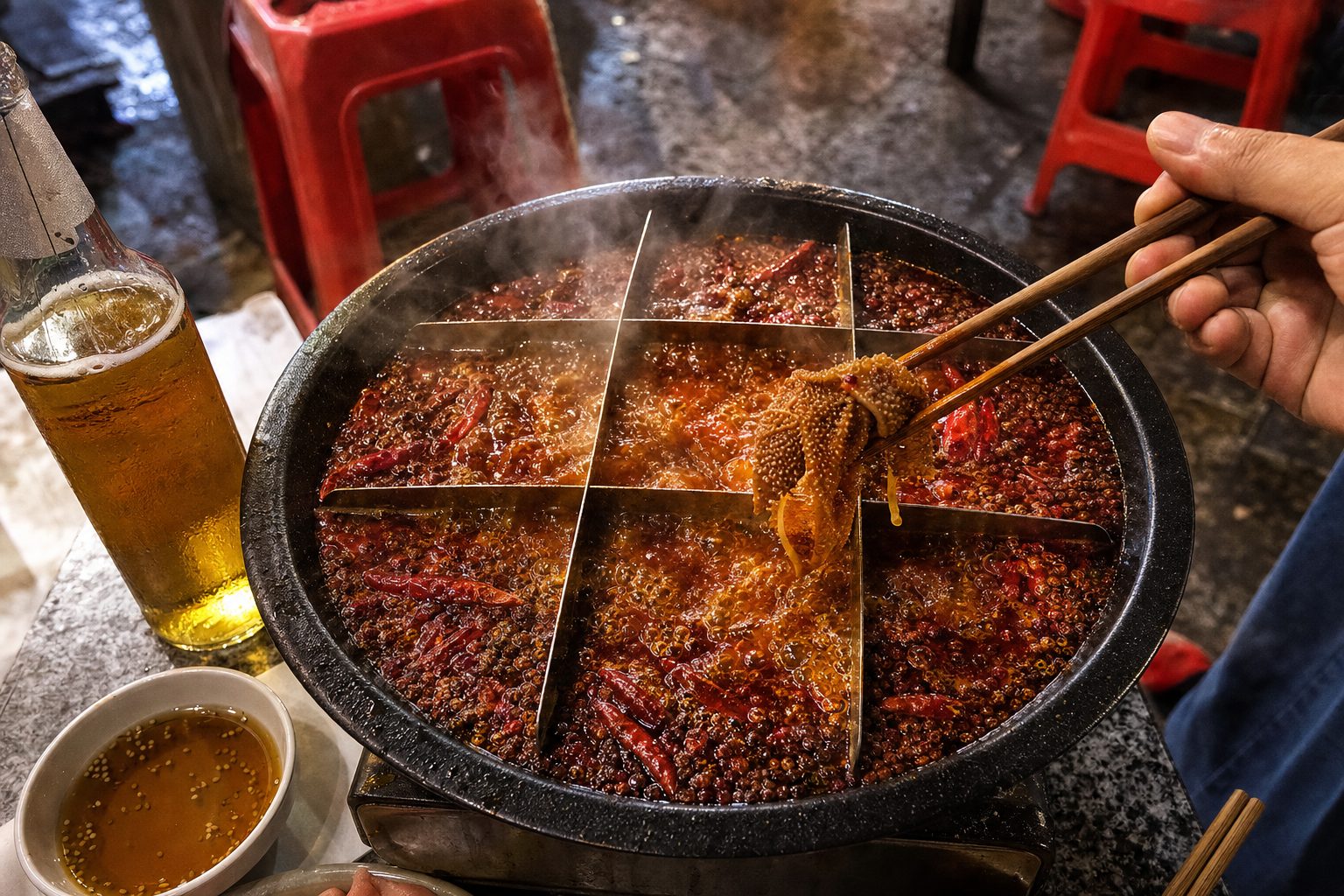
- in chongqing, 微辣 (wēi là, "mild") is already spicier than most places' hot. start there. seriously
- the nine-grid pot (九宫格) has hot zones: the center boils hardest for quick dips, corners simmer slow for potatoes and duck blood
- order maodu (beef tripe), yachang (duck intestine), tender beef and fried pork. dip tripe seven or eight times, about 10–15 seconds
- the dipping oil is sesame oil + a lot of garlic. it's not just flavor, it's a heat shield
- local spots run roughly $10–20 per person as of late 2026. chains cost a bit more but are easier
on my third trip to china, i had a dumb idea: one week in chongqing, hotpot every day, no skipping. jules said it was “a cry for help.” jules then came along and ate most of the tripe.
seven pots later, i have notes. some are useful. some are just a record of what happened to my body. here’s both.
why chongqing hotpot is different
chongqing is basically the hotpot capital of china. the classic broth is beef tallow (牛油) loaded with dried chilies and sichuan peppercorn. it shows up at your table as a solid red brick that melts into a bubbling lake. it’s richer, oilier and spicier than most hotpot you’ve had at home (and spicier than chengdu’s — more on that rivalry in chengdu vs chongqing).
it’s also cheaper than you’d think. a full meal at a local spot usually lands around $10–20 per person, depending on how hard you go on meat. as of late 2026, that’s been pretty stable, but menus vary a lot.
if you want the wider city context first, the chongqing guide covers where to stay and how not to get lost. this one’s just about the pot.
chongqing hotpot spice levels (and the night i got humbled)
here’s the scale you’ll see on almost every menu:
| level | chinese | what it actually means |
|---|---|---|
| not spicy | 不辣 / 清汤 (bù là / qīng tāng) | clear or mushroom broth. safe |
| mild | 微辣 (wēi là) | already spicy by most standards |
| medium | 中辣 (zhōng là) | serious. your nose will run |
| extra hot | 特辣 (tè là) | for locals and people with something to prove |
day one, i ordered 微辣 like a good boy. it was hot but fine. day two, also fine. by day three i’d decided i was built different.
so on day four, at a tiny neighborhood place down a staircase near jiefangbei (one of the chongqing neighborhoods worth basing yourself in), i pointed at 特辣 on the menu. the auntie running the place looked at me, looked at jules, and said something i didn’t catch. jules held up a translate app: “are you sure?” i said “没问题” (méi wèntí, no problem) with full confidence and absolutely incorrect tones.
it was a problem.
the first piece of beef was fine for about two seconds. then my lips went numb, my ears got hot, and i started sweating from a part of my scalp i didn’t know had pores. i drank an entire bottle of cold soy milk and then did what every chongqing table eventually does to foreigners: i sat in silence and stared at the ceiling.
the auntie came by, laughed (kindly), and dropped off a bowl of 冰粉 (bīngfěn), a cold jelly dessert with brown sugar syrup, without me ordering it. i think she’d seen this exact movie before.
the lesson: chongqing’s 微辣 is the real “medium.” the spice here also stacks. the first ten minutes feel fine, and then it compounds. order low, and if it’s too easy, you can always ask them to add chilies.
how the nine-grid pot works
a lot of chongqing places use the 九宫格 (jiǔgōnggé), a pot split into nine squares by a metal grid. it’s the same broth everywhere, but each square heats differently:
- the center square sits over the strongest flame and boils the hardest. use it for quick dips: tripe, duck intestine, thin beef
- the four edge squares are medium heat. good for meatballs, beef slices and veggies that need a minute or two
- the four corners run coolest. drop in stuff that needs to simmer, like potato slices, lotus root and duck blood, and come back later
the real reason locals love it, though, is that your food doesn’t get lost. jules and i each “claimed” two squares. no more fishing for a mystery meatball that might be yours.
it’s also lowkey genius for groups. each person gets their own lanes, and the center is shared territory.
what to order at chongqing hotpot
you’ll usually order on a paper checklist or by scanning a qr code at the table. if it’s all in chinese, camera-translate it or just point at the photos. our chinese food guide walks through qr ordering step by step.
after seven nights, this is my order, roughly in the order i’d rank it:
- 毛肚 (máodù), beef tripe. the main character of chongqing hotpot. black, frilly and crunchy. it’s the thing everyone orders
- 鸭肠 (yāchǎng), duck intestine. sounds scary, tastes like a crispy, springy noodle. it cooks in about 10–15 seconds
- 嫩牛肉 (nèn niúròu), tender marinated beef. often coated in chili and pepper already. drop it in the center and pull it fast
- 酥肉 (sūròu), crispy fried pork. you can eat it straight as a snack or dunk it. day five, jules ordered two plates and i did not intervene
- 黄喉 (huánghóu), aorta. chewy and crunchy, not for everyone. it’s very local, and i ended up loving it
- 鸭血 (yāxuè), duck blood. silky little cubes. corners only, let them simmer
- 土豆片 (tǔdòu piàn) and 藕片 (ǒu piàn), potato and lotus root slices. cheap, filling, and they soak up the broth
- 宽粉 (kuān fěn), wide sweet potato noodles. order them near the end, when the broth is at its best
the tripe rule: seven up, eight down
locals cook tripe with 七上八下 (qī shàng bā xià): seven ups, eight downs. hold a piece with your chopsticks, dip it in the center square, lift, and repeat about seven or eight times. that’s roughly 10–15 seconds. it should curl slightly and stay crunchy.
go longer and it turns into a rubber band. i learned this on day one by losing a piece of tripe in the pot for five minutes. it was like chewing a phone case.
the dipping oil (油碟) is your heat shield
the classic chongqing dip is the 油碟 (yóudié): a little bowl of sesame oil with a lot of minced garlic. people usually add some cilantro, scallion and a splash of oyster sauce or vinegar from the sauce bar.
it’s not just for flavor. the sesame oil coats the food and cools it down before it hits your mouth. on the 特辣 night, the oil bowl was the only reason i survived.
some places charge a small fee for the sauce or a per-person sauce-bar fee, usually well under a dollar. totally normal.
honestly, if i did this again, i’d do a food tour on night one. a local guide gets you down the right staircases and orders things you’d never point at yourself. after that, you’re confident enough to go solo.
local hole-in-the-wall vs chain hotpot
i tried both. they’re both good, they’re just different trips.
local neighborhood spots
- plastic stools, hand-written menus, sometimes literally under an overpass or down an alley
- often only chinese menus, often only the red pot
- usually cheaper and spicier
- the broth tends to be heavier on tallow, which is the “real” chongqing taste
- the best way to find them: look for full tables at 10pm and a crowd of locals on dianping (大众点评)
big chains (like haidilao)
- picture or english menus, very friendly staff, often free snacks or nail care while you wait
- easy split pots and lots of broth options
- a bit more expensive, but still reasonable
- great training wheels for day one
my honest take: start at a chain if you’re nervous, then go local by night two or three. the local spots are where the week got really fun.
how to survive a week of chongqing hotpot
my stomach and i came to an agreement around day five. here’s what helped:
- drink cold soy milk (豆奶) or herbal tea, not water. water spreads the oil around. soy milk actually calms it down
- order 冰粉 for dessert. cold, sweet and soothing. it’s basically medicine
- don’t drink the red broth. it’s mostly oil and chili. i saw a tourist try it once. he was quiet for a long time after that
- mix in a clear broth night. on day six we went to a place with a mushroom broth option. my body sent a thank-you note
- eat a real breakfast. a bowl of chongqing 小面 (xiǎomiàn) noodles in the morning for around $1.50 sounds like more chili, but it helps to have food in you before the next pot
- pack basic stomach meds. i’m not saying you’ll need them. i’m saying i did once
- stay walkable. being able to walk home from hotpot at midnight was the best decision of the trip
we stayed near jiefangbei, and like 30 hotpot places were within a 10-minute walk. that’s the move if food is the plan.
chongqing vs chengdu hotpot
we ended the week with a train to chengdu, around an hour away, and had hotpot there too (i know, i have a problem).
chengdu hotpot is often a little gentler, with more vegetable-oil-based broths and more 麻 (the numbing tingle) than raw fire. chongqing goes heavier on beef tallow and heat. both are amazing, and if you’re doing both cities, compare them on purpose. the chengdu guide has more on eating there.
the vibe check
seven days, seven pots. i lost one fight with 特辣, gained a deep respect for duck intestine, and now say “七上八下” out loud whenever i see tripe, which jules finds unbearable.
if you’re going: order 微辣, get a nine-grid pot, start with maodu and yachang, make a garlicky sesame oil dip, and drink soy milk instead of water. try one chain and at least one tiny local place down a staircase. and if an auntie asks “are you sure?”, trust her. she knows.
the kit for this trip
heads up: some links above are affiliate links. if you book through them we earn a small commission at no extra cost to you — it keeps this guide free. more on that.