what china believes
10% religious, 75% at the graves
the gap between these numbers is the whole story
- only about 10% of chinese adults say they belong to a religion (cgss 2018, via pew research center).
- but 33% say they believe in buddha or a bodhisattva, 47% believe in fengshui, and about three-quarters visited a family grave in the past year.
- the gap is mostly about the word zongjiao (宗教, 'religion'), which suggests a formal institution. lots of practice gets filed under custom instead.
- temple visits by young people surged after 2023. as a visitor, expect busy temples, real worshippers, and a lot of quiet wishing.
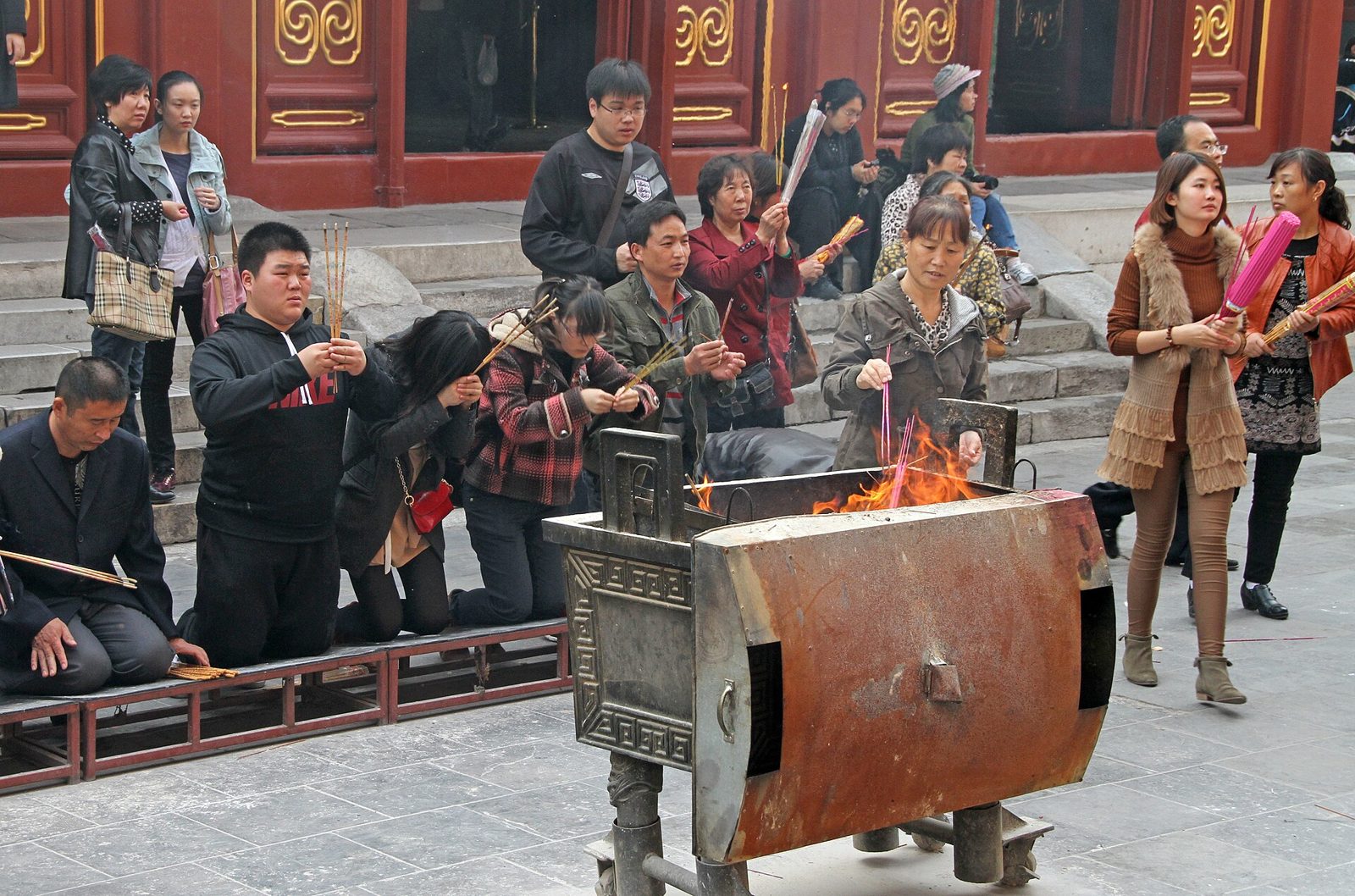
the first time i went to the lama temple in beijing, i expected a museum. what i got was smoke. hundreds of people, a lot of them my age or younger, kneeling on little red benches with fistfuls of incense, eyes closed, lips moving. a guy in a north face jacket bowed in all four directions and then checked his phone.
later that week a chinese friend told me, completely sincerely, “oh, i’m not religious.” she had a jade guanyin on her keychain.
that’s not hypocrisy. it’s the most interesting thing about religion in china, and the numbers show it really clearly.
religion in china, by the numbers
10 in 100 chinese adults say they belong to any religion when asked about their zongjiao (宗教) belief.
“zongjiao” implies an organized, institutional religion — a label many people who pray and burn incense simply don’t apply to themselves.
source: pew research center, 2023 (cgss 2018)4 in 100 chinese adults claim buddhism as their religious belief.
in the same survey, about 3% identify with folk religion and about 2% with christianity — the small numbers are about labels, not about how many people visit temples.
source: pew research center, 2023 (cgss 2018)2 in 100 chinese adults self-identify with christianity — roughly 20 million people.
pew notes that broader measures (belief in the christian god, worship attendance) put as many as 8% with some connection to christianity.
source: pew research center, 2023 (cgss 2018)33 in 100 chinese adults say they believe in buddha and/or a bodhisattva.
that’s eight times the share who call themselves buddhist — the clearest example of belief running ahead of identity.
source: pew research center, 2023 (cfps 2018)26 in 100 chinese adults burn incense to buddha or other deities at least a few times a year.
that includes 11% who do it at least once a month, at home or at a temple.
source: pew research center, 2023 (cfps 2016)24 in 100 chinese adults visited a temple or shrine in the past year to pray for wealth or good fortune.
think exams, business, a job hunt — 10% did it two or more times that year.
source: pew research center, 2023 (cgss 2018)47 in 100 chinese adults say they believe in fengshui.
many people treat fengshui as custom or common sense rather than religion, which is part of why it scores so high.
source: pew research center, 2023 (cfps 2018)75 in 100 chinese adults visited a family member’s gravesite at least once in the past year.
pew reports this as “three-quarters”; only 14% made the full traditional three visits (qingming, new year, the death anniversary).
source: pew research center, 2023 (cgss 2018)all the numbers
| 10 in 100 chinese adults say they belong to any religion when asked about their zongjiao (宗教) belief. | 10% | pew research center, 2023 (cgss 2018) |
| 4 in 100 chinese adults claim buddhism as their religious belief. | 4% | pew research center, 2023 (cgss 2018) |
| 2 in 100 chinese adults self-identify with christianity — roughly 20 million people. | 2% | pew research center, 2023 (cgss 2018) |
| 33 in 100 chinese adults say they believe in buddha and/or a bodhisattva. | 33% | pew research center, 2023 (cfps 2018) |
| 26 in 100 chinese adults burn incense to buddha or other deities at least a few times a year. | 26% | pew research center, 2023 (cfps 2016) |
| 24 in 100 chinese adults visited a temple or shrine in the past year to pray for wealth or good fortune. | 24% | pew research center, 2023 (cgss 2018) |
| 47 in 100 chinese adults say they believe in fengshui. | 47% | pew research center, 2023 (cfps 2018) |
| 75 in 100 chinese adults visited a family member’s gravesite at least once in the past year. | 75% | pew research center, 2023 (cgss 2018) |
every statistic here comes from pew research center’s 2023 report measuring religion in china, which analyzes big chinese national surveys: the chinese general social survey (cgss) and the china family panel studies (cfps). tap through and watch the dots refill. the low numbers are about identity. the high ones are about practice.
why so few people say they’re “religious”
the key is one word. when a survey asks about your religion, it uses zongjiao (宗教). pew points out that zongjiao is usually understood as organized religion, with clergy, scriptures, membership and a formal institution. it’s a fairly modern word, too: chinese scholars adopted it in the early 20th century when they needed a way to translate the western idea of “religion.”
so a grandmother who burns incense to guanyin on the 1st and 15th of every month, keeps an ancestor altar and consults the almanac before a wedding might honestly answer “no religion.” she isn’t in a club. she’s just doing what her family does.
pew lays out a spectrum: things the state recognizes as religion, things people call custom (xisu 习俗, like grave-sweeping), and things sometimes labeled superstition (mixin 迷信). the lines between them are fuzzy, and pew notes that some people consider fortune telling and fengshui to be customs, not superstitions. a lot of what westerners would call religion lands in the custom bucket, so it doesn’t show up when you ask about identity.
folk religion: the thing nobody joins
under buddhism, daoism and confucianism (see our three teachings explainer) there’s a huge layer of popular religion. it includes local gods, the kitchen god, the god of wealth, earth gods in tiny roadside shrines, ghosts that need appeasing, and above all ancestors.
pew finds that only about 3% of chinese adults formally identify with folk religion. but the practices are everywhere, and they mix freely. about 40% believe in at least one of buddha or a bodhisattva, daoist deities, ghosts or other gods, and 20% believe in more than one. just 5% say they believe in buddha exclusively.
that’s the pattern in one sentence: belief here is additive, not exclusive. you don’t convert, you accumulate.
ancestors and qingming
the biggest number on the board is the quietest one: about three-quarters of chinese adults visited a family member’s grave in the past year (cgss 2018).
most of those visits happen at qingming (清明, tomb-sweeping day, early april). families clean the grave, leave food, fruit and liquor, burn joss paper and “spirit money,” and bow. some burn paper models of phones, cars and designer bags so their ancestors are comfortable in the afterlife. pew notes that tradition calls for grave visits three times a year (qingming, lunar new year and the death anniversary), but only 14% made all three.
is that religion? it depends on who you ask, and that’s kind of the point. for a lot of families it’s filial duty, a reunion and a day out all at once.
young people at temples
if you’ve scrolled chinese social media lately you’ve seen it: twenty-somethings at temples, buying sandalwood bracelets, praying for exam scores or job offers. sixth tone reported in march 2023 that temple bookings on trip.com had more than tripled year on year, with young people making about half of those bookings, and that beijing’s lama temple was seeing more than 40,000 visitors a day.
the explanations people give are a mix: stress relief after the pandemic, a tough job market, a trend that photographs well, and some sincere faith. one 25-year-old quoted in that piece put it simply: between asking yourself for help and asking others for help, they’d rather ask the buddha. scholars quoted in coverage are split on how much of it is belief and how much is vibe. it’s probably both, and that fits the numbers above perfectly.
pew’s data matches the mood: 24% of adults visited a temple or shrine in the past year to pray for wealth or good fortune. that’s roughly one in four people asking the universe for a little help with life.
what this means for you as a visitor
- temples are living places, not museums. you will see real worship (and how to read a chinese temple explains what you’re looking at). give people space at the incense burners and kneeling cushions, and don’t take close-up photos of someone mid-prayer.
- you’re welcome to take part. lighting incense or making a wish isn’t appropriation, it’s what most visitors do, chinese and foreign. three sticks, a bow, no big deal.
- busy days are lunar dates. the 1st and 15th of the lunar month, lunar new year and big festivals (see chinese festivals through the year) pack temples, especially the famous wishing spots like the lama temple, lingyin temple in hangzhou and jing’an temple in shanghai.
- “are you religious?” is a weird question here. the more interesting one is “what does your family do at qingming?” people love answering that.
- churches and mosques exist too. about 2% of adults identify as christian (cgss 2018), and islam has deep roots, especially in xi’an’s muslim quarter. see our xi’an guide.
the vibe check
china is often described as one of the least religious countries on earth, and if you only look at labels, that holds up. but walk into any temple on the 15th of the lunar month, or drive past a hillside cemetery at qingming, and the picture changes completely. the honest summary: few people belong, and a lot of people practice. bring curiosity, step over the threshold, and maybe make a wish. you’re in good company.
the kit for this trip
heads up: some links above are affiliate links. if you book through them we earn a small commission at no extra cost to you — it keeps this guide free. more on that.