chengdu neighborhoods
five chengdus, one slow city
base at taikoo li, spend your afternoons at wenshu
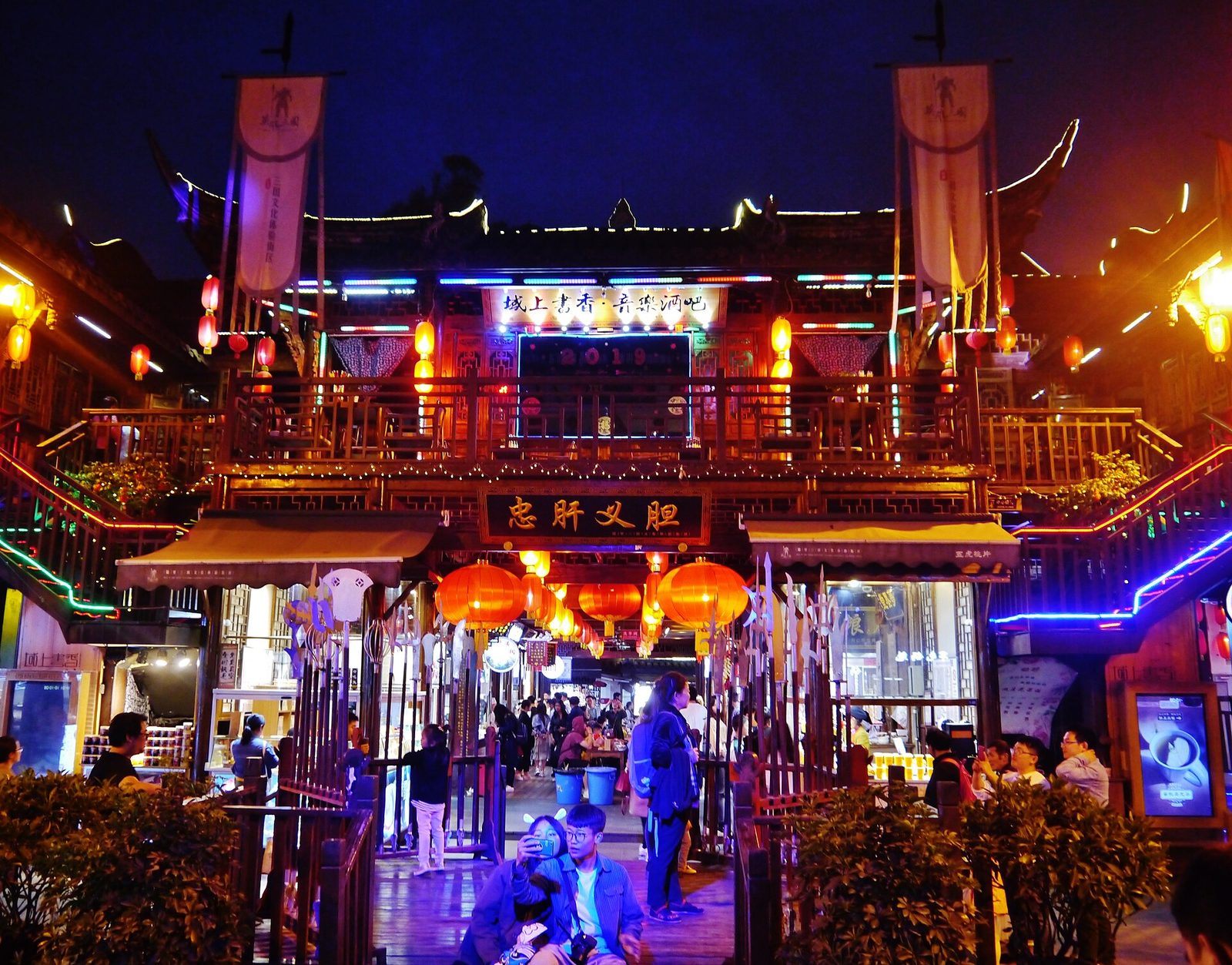
- taikoo li / chunxi road is the easiest base: metro lines 2 and 3, food at every hour, and a tang dynasty temple in the middle of the mall.
- kuanzhai alley is what's left of a qing garrison city built for manchu bannermen after 1718. go before 10am.
- wenshu monastery is the cheapest calm in chengdu: a working temple with a giant teahouse and a vegetarian canteen.
- yulin is the neighborhood from zhao lei's song 'chengdu'. come after 8pm for bars and skewers.
- wuhou shrine is three kingdoms central: liu bei's tomb and zhuge liang's temple, side by side. jinli next door is a rebuilt lantern street.
there’s an old sichuan saying: shao bu ru chuan — “the young shouldn’t go to sichuan.” the idea is that life there is so comfortable (good food, cheap tea, mild weather, nobody in a hurry) that an ambitious young person would get there and simply never leave.
chengdu has been living up to that warning for about two thousand years (the food alone is reason enough — see the chinese food guide). it’s the city of teahouses, mahjong on the sidewalk, and the word bashi — roughly “this is so comfy and right.” but “chengdu” isn’t one vibe. the qing garrison lanes, the buddhist quarter, the luxury-mall-around-a-temple, the indie bar street and the three kingdoms shrine all feel completely different.
so here are five of them, mapped by how old they feel and how loud they get.
the chengdu neighborhood map
tap a neighborhood. placement is our vibe read, not science.
kuanzhai alley + the old manchu city 宽窄巷子 · 少城
grey-brick courtyards from a qing garrison town, now with lattes
the backstoryin 1718 the kangxi emperor sent banner troops to chengdu after a dzungar war in tibet, and some of them stayed: the qing walled off a 'lesser city' (shaocheng) on the west side just for manchu and mongol bannermen and their families, laid out in a grid of beijing-style hutongs. after the qing fell in 1911 the walls came down and the lanes slowly filled with ordinary chengdu families, but three survived as a set — kuan (wide), zhai (narrow) and jing (well) alley. they were heavily rebuilt and reopened in 2008 as the restored strip you walk today: the courtyard gates are real in spirit, the shops are very 2020s.
you’ll love it iffirst-timers who want old chengdu in one walkable hit, and anyone who'd trade an hour of sightseeing for an hour in a courtyard teahouse.
- kuan xiangzi (wide alley)go early and look at the gates: carved lintels, stone drum blocks, little courtyards you can peek into. this is the best-preserved feel of the old banner lanes.
- zhai xiangzi + jing xiangzidrift through the narrow alley's cafes, then the well alley's long brick wall, which is covered in reliefs of old chengdu street life.
- people's park + heming teahousewalk ~10 minutes east to the park — it was carved out of the manchu city in 1911 — and claim a bamboo chair by the lake for tea, ear cleaning and people-watching.
- san da pao (three big cannons)sticky rice balls thrown so they thump off a brass-studded board before landing in soybean powder and brown sugar. it's a show and a snack for ~$1–2.
- gaiwan tea at heming teahousea lidded cup of jasmine or green tea with endless hot-water refills, roughly $3–6. you're paying for the afternoon, not the leaves.
wenshu monastery area 文殊院
incense, ginkgo trees and the cheapest calm in the city
the backstorya temple has stood here since at least the tang dynasty, when it was called xinxiang temple. it was wrecked in the late-ming wars, and in 1681 a monk called cidu turned up and lived in a hut between two trees on the ruins; legend says a figure of wenshu (manjushri, the bodhisattva of wisdom) appeared in the flames at his cremation, and the temple took the name. the halls you see were rebuilt between 1697 and 1706 under the kangxi emperor, and it's still a working monastery with monks, chanting and a vegetarian canteen.
you’ll love it ifslow travelers, budget travelers and anyone who wants a temple that feels lived-in rather than staged.
- wenshu monasterywalk the axis of halls, watch the incense, and look for the thousand-buddha pagoda at the back. entry has generally been free — just don't wear shorts into the halls.
- the monastery teahousea huge open courtyard of bamboo chairs under trees, full of retirees with flasks and newspapers. one of the cheapest, calmest cups in chengdu.
- wenshufang lanesthe rebuilt grey-brick blocks around the temple are full of incense shops, snack stalls and little noodle places. it's touristy but low-key compared to jinli.
- vegetarian lunch at the monasterythe temple's own restaurant does mock-meat sichuan dishes — fish-fragrant 'pork', mapo tofu without the pork — for well under $10.
- zhong shuijiao (zhong dumplings)pork dumplings in sweet-garlicky red chili oil, a century-old chengdu snack. ~$2–3 a plate around the temple lanes.
taikoo li + chunxi road 太古里 · 春熙路
a tang dynasty temple wrapped in a luxury mall, and it works
the backstorychunxi road was laid out in 1924 to connect two older market districts, and its name comes from a line in laozi's daodejing about crowds bustling happily 'as if climbing a terrace in spring' — a 100-year-old prophecy for a shopping street. next door is daci temple, a buddhist site that goes back to the tang dynasty; tradition says the monk xuanzang was ordained in chengdu and studied here before his famous trip to india. when swire and sino-ocean built taikoo li around it (opening in stages around 2014–15), they kept the temple and designed low-rise, sichuan-style pitched roofs around it instead of a glass box.
you’ll love it iffirst-timers who want the easiest base, shoppers, people-watchers and anyone who wants to eat 20 things in one evening.
- daci templestart inside the temple — quiet halls, old trees, and locals drinking tea in the courtyard while gucci sits 50 meters away.
- taikoo li laneswander the open-air blocks of dark-tiled roofs and fashion flagships. it's one of the best street-fashion runways in china.
- chengdu ifs + chunxi roadfind the giant panda climbing up the side of the ifs mall, then walk chunxi road's pedestrian strip as the screens light up.
- long chaoshou (dragon wontons)a famous old chengdu wonton brand with a shop near chunxi road. silky wontons in a clear or chili broth, ~$2–4.
- chuan chuan or hotpot on a side streetthe side streets off chunxi road are wall-to-wall skewer and hotpot joints. go where the queue is locals.
yulin 玉林
the song, the little bar, and plane trees over plastic stools
the backstoryyulin is mostly a 1990s neighborhood of mid-rise apartment blocks south of the center — no temples, no ancient walls. what it has is a scene: in 1997 the painter tang lei opened little bar (xiao jiuguan) on yulin west road, and it became a home for chengdu's indie and rock musicians through the 2000s. then folk singer zhao lei's song 'chengdu' (released in 2016, a huge hit by 2017) name-checked yulin road and the little bar, and suddenly the whole country wanted to walk to the end of yulin road. somehow the neighborhood still feels like people live here.
you’ll love it ifnight owls, music fans, and anyone who likes neighborhoods more than sights.
- yulin west road + little barstart at the original little bar for a beer and a photo of the door. it's tiny; that's the point.
- yulin back laneswander the side streets: tiny bars, record shops, coffee in converted ground floors, grandmas playing mahjong on the pavement.
- a late skewer jointend where everyone ends: a chuan chuan place with a bubbling pot and a pile of sticks, counted at the end to make the bill.
- chuan chuan xiangskewers you cook yourself in a communal pot of spicy broth, paid per stick — usually a few dollars for a feast.
- mao caichengdu's 'hotpot for one': you pick ingredients, they're cooked in a spicy broth and served in a bowl. a cheap, filling late-night move at ~$3–6.
wuhou shrine + jinli 武侯祠 · 锦里
three kingdoms heroes by day, red lanterns by night
the backstorychengdu was the capital of shu han, the state liu bei founded in 221 during the three kingdoms period, and he was buried here in 223. his brilliant chancellor zhuge liang — posthumously titled 'wuhou', marquis of loyalty and martial valor — got a memorial temple nearby, and in the ming dynasty the two shrines were merged, which makes this one of the very few places in china where a ruler and his minister are honored in one complex. the current halls date mostly from a 1672 rebuild. next door, jinli is a rebuilt 'old street' from the 2000s — newer than it looks, but a lot of fun with the lanterns lit.
you’ll love it ifhistory fans, three kingdoms gamers and readers, and anyone who wants a temple by day and a street-snack crawl by night.
- wuhou shrinelook for the hall of shu han generals and zhuge liang's statue, then follow the red-walled, bamboo-lined path to liu bei's grass-covered burial mound. tickets have been around $7.
- jinli ancient streetexit to jinli for teahouses, shadow-puppet stalls and street snacks. it's a recreation, so enjoy it as theater.
- wuhou shrine side streetsloop around the block to the streets nicknamed 'little lhasa', where tibetan shops sell prayer flags, yak butter and turquoise.
- tianshui mian (sweet water noodles)thick, chewy noodles in a sweet, spicy, garlicky sauce. one of chengdu's classic snacks, ~$2 a bowl.
- spicy rabbit headyes, really. chengdu goes through rabbit heads like popcorn. jinli stalls sell them for a few dollars; you'll be the main character in the group chat.
tap a dot to open the card. each one has the real history, a perfect three hours in walking order, two things to eat and the nearest metro.
a city that’s been the capital before
before you pick a neighborhood, a little context, because chengdu’s layout is a history lesson.
the shu han years. in 221, during the three kingdoms period, liu bei declared himself emperor of shu han with chengdu as the capital. his chancellor zhuge liang — strategist, inventor, and still the patron saint of clever people in china — ran the state for years after liu bei died in 223. the wuhou shrine in the south of the city is where liu bei is buried and where zhuge liang is honored, in one complex. if you’ve played dynasty warriors or total war: three kingdoms, this is your pilgrimage.
the manchu city. fast forward to 1718. the qing kangxi emperor sent banner troops to chengdu after a dzungar war in tibet, and a garrison stayed. the qing built them their own walled “lesser city” (shaocheng) on the west side, laid out in a grid of beijing-style hutongs. after the qing fell in 1911, the walls came down and ordinary chengdu moved in. kuanzhai alley — wide alley, narrow alley and well alley — is the surviving fragment. people’s park was carved out of that same manchu city in 1911, which is why the two are a 10-minute walk apart.
the teahouse city. through all of it, chengdu drank tea in public. historian wang di wrote a whole book (the teahouse) on how chengdu’s teahouses worked as the city’s living room: business deals, gossip, opera, arguments. that culture never left. it’s why every neighborhood below has a teahouse in its “perfect 3 hours.”
kuanzhai alley vs taikoo li: where should you stay in chengdu?
this is the real question for most first-timers.
taikoo li / chunxi road is our default pick. lines 2 and 3 meet at chunxi road station, the panda base is an easy didi or metro ride away, and you’re surrounded by hotpot, wontons and skewers until late (wontons here are chaoshou — see the dumpling family tree). the twist: right in the middle of the luxury mall is daci temple, a buddhist site going back to the tang dynasty. tradition says the monk xuanzang (yes, the journey to the west one) was ordained in chengdu and studied here before heading to india.
kuanzhai alley is the pick if you want atmosphere: courtyard boutique hotels, grey-brick lanes before the crowds, and people’s park for morning tea. the trade-off is that it gets busy by mid-morning and the lanes are more restored than ancient.
wenshu monastery is the budget-and-chill pick (and a great place to practice how to read a chinese temple). one stop from the center on line 1, quieter streets, and the monastery teahouse becomes your second home.
| neighborhood | old ↔ new | sleepy ↔ chaotic | stay here if |
|---|---|---|---|
| kuanzhai alley | old-ish (rebuilt 2008) | busy by day | you want courtyard hotels |
| wenshu | ancient soul | sleepy | you want calm + cheap |
| taikoo li / chunxi | brand new | chaotic | first trip, max convenience |
| yulin | 1990s | lively at night | you want to live like a local |
| wuhou + jinli | ancient | busy at night | you’re a three kingdoms nerd |
the best chengdu neighborhood for teahouses
if you only do one thing in chengdu besides pandas, sit in a teahouse for two hours with nothing to do. there are three great ones in these neighborhoods:
- heming teahouse, people’s park (by kuanzhai alley): founded in 1923, by the lake, bamboo chairs, professional ear cleaners walking the rows with their tuning-fork ting sound. a cup runs roughly $3–6.
- wenshu monastery teahouse: a courtyard of retirees under old trees. one of the cheapest and calmest cups in the city.
- daci temple, taikoo li: the most surreal. monks and incense on one side of the wall, flagship stores on the other.
i did the whole people’s park afternoon in this teahouse story, ear cleaning included. 10/10, my ears have never been so quiet.
yulin: the neighborhood from the song
yulin is the one that surprises people because it has no “sights.” it’s a 1990s apartment neighborhood south of the center. what it has is a soundtrack: the little bar opened on yulin west road in 1997 and became a home for chengdu’s indie and rock scene, and then zhao lei’s folk song “chengdu” name-checked yulin road and the little bar. the song went massive around 2017 and now people from all over china walk to “the end of yulin road” to see if it’s real.
it is. it’s also just a nice neighborhood: plane trees, plastic stools, skewer joints that count your sticks at the end. go after 8pm, take line 3 to yiguanmiao and walk.
wuhou shrine + jinli: the three kingdoms half-day
do the shrine in the morning. walk past the halls of shu han generals and officials, find zhuge liang’s statue, then follow the famous red-walled path lined with bamboo to liu bei’s grassy burial mound. it’s one of the very few places in china where a ruler and his minister share a memorial complex — the ming merged the two temples, and the current buildings mostly date from a 1672 rebuild.
then exit into jinli, the lantern-hung “ancient street” next door. full honesty: it’s a 2000s recreation. but at night, with the lanterns lit and a bag of san da pao in your hand, nobody cares. loop around the block to the streets locals call “little lhasa” for tibetan shops and a completely different energy.
a two-day chengdu neighborhood plan
- day 1: panda base at opening (book ahead — see the chengdu guide), back for lunch in taikoo li, afternoon tea at daci temple, hotpot off chunxi road.
- day 2: kuanzhai alley before 10am, heming teahouse in people’s park, wuhou shrine after lunch, jinli at dusk, end with skewers in yulin.
if you’re also doing chongqing, the cities are about an hour apart by high-speed train — here’s how they compare and how its neighborhoods stack up.
the vibe check
chengdu’s neighborhoods are five different moods of the same slow city. stay at taikoo li if it’s your first trip, wake up early in kuanzhai alley, give yourself one long afternoon in a teahouse, and end at least one night on a plastic stool in yulin. the saying was right: you’ll have to drag yourself out.
the kit for this trip
heads up: some links above are affiliate links. if you book through them we earn a small commission at no extra cost to you — it keeps this guide free. more on that.