how to read a temple
si, guan or miao? read the roof
the roof tells you more than the gift shop does
- read the last character of the name: si 寺 / an 庵 / yuan 院 = buddhist, guan 观 / gong 宫 = daoist, wenmiao 文庙 / kongmiao 孔庙 = confucian. miao 庙 alone is a loose, catch-all word.
- almost every temple runs on one north-south line: front gate → hall of heavenly kings → main hall, each one bigger and higher than the last.
- buddhist = shaved-head buddhas on lotuses. daoist = bearded gods dressed like officials, plus bagua and gourds. confucian = a name tablet, not a giant statue.
- etiquette: step over the threshold, not on it. walk clockwise around stupas. look for no-photo signs inside halls. most big temples give you incense free, so skip the touts selling 'lucky' giant sticks.
somewhere around day three of a china trip, every temple starts to look the same: red walls, golden roof, incense smoke, a guy selling bottled water by the gate. here’s the thing, though. they aren’t the same, and once you can read them it’s like the buildings start talking to you.
chinese temples are written in a visual language: names, roof shapes, colors, what sits on the altar, even how many tiny beasts are perched on the roof corners. below are four real temples, one of each kind. tap the numbers.
the temple decoder (tap to explore)
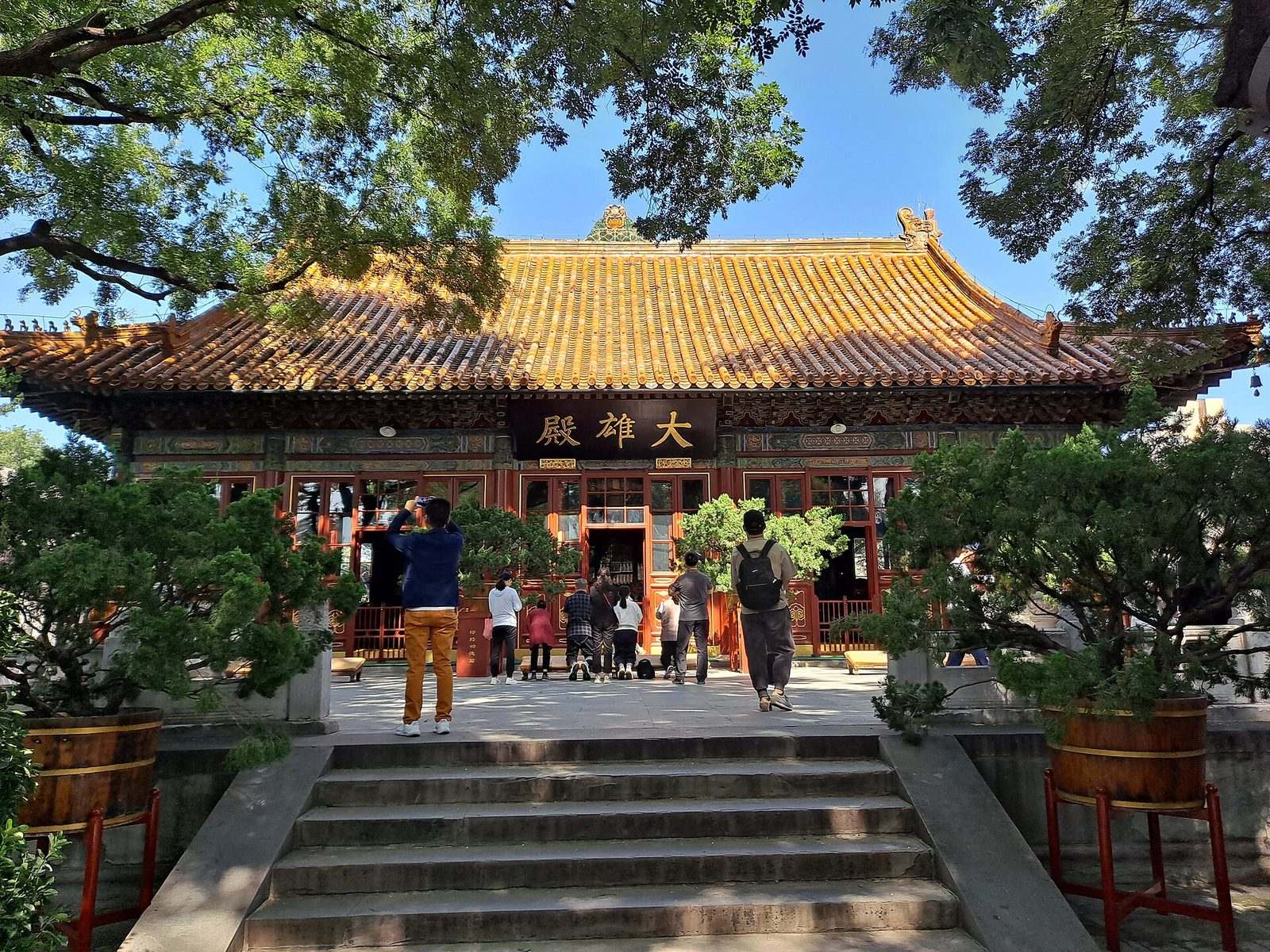
the buddha hall, from the courtyard 大雄殿 · 广济寺
the main hall of guangji temple (广济寺) in west beijing, a working monastery that's also the headquarters of the buddhist association of china. this is the building every chinese buddhist temple builds toward: the 'hall of the great hero', where the buddha lives.
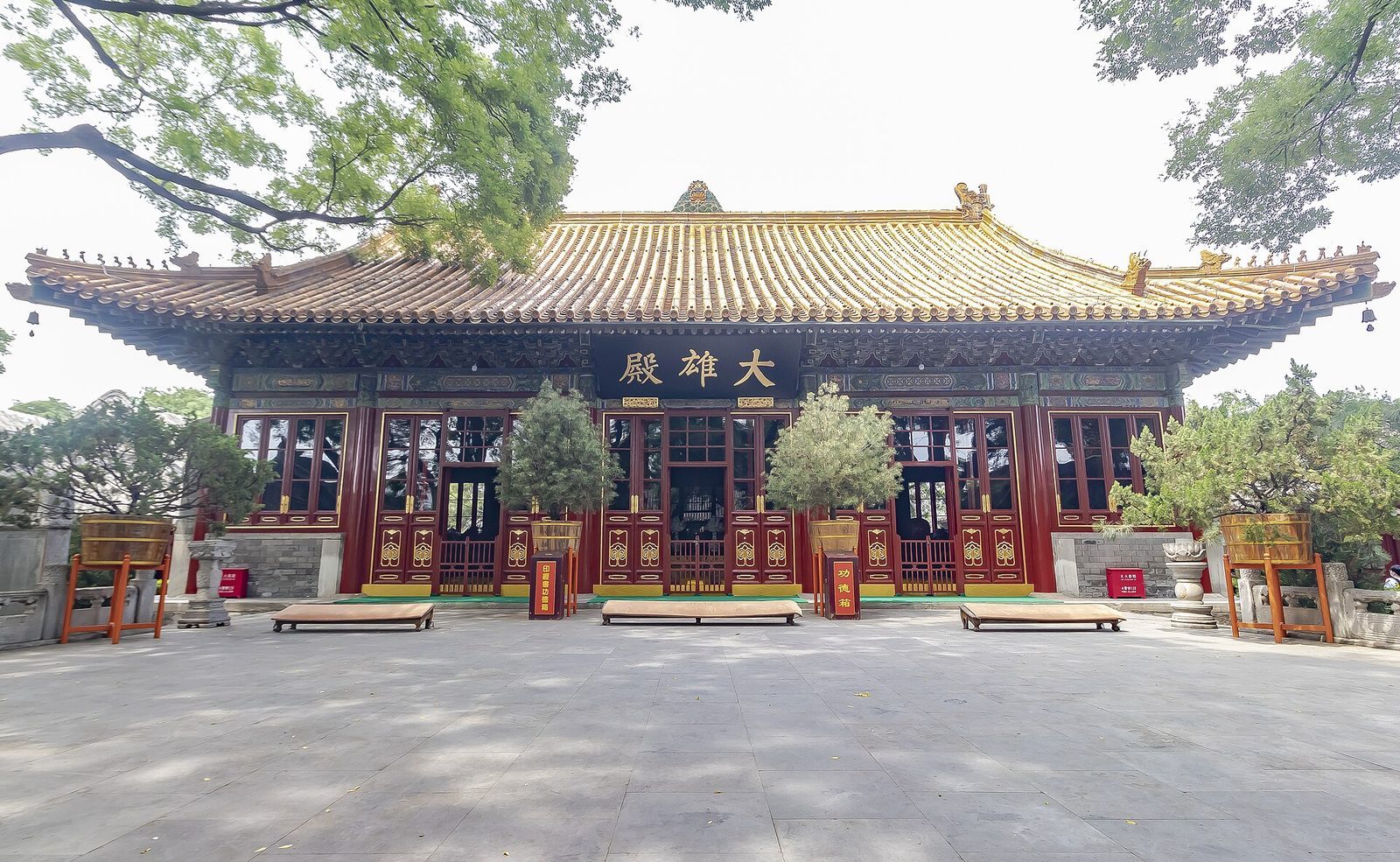
- 1the name board 大雄殿, daxiong dian: 'hall of the great hero'. the great hero is the buddha himself. most temples say 大雄宝殿 ('precious hall'); spot either and you know you're at the heart of a buddhist temple, not a daoist or confucian one.
- 2the ridge dragons look up at the ends of the main ridge: a dragon-headed ornament with its mouth clamped onto the roof (a chiwen, 鸱吻). folk belief says this water creature keeps the wooden building from burning. it's the exact same piece you'll see on palace roofs.
- 3the little roof parade on the corner ridges sits a single-file line of tiny glazed beasts. it's a rank badge: the more figures, the more important the building. the forbidden city's hall of supreme harmony maxes out at ten. count these ones while you're standing in line.
- 4the middle door the hall's front is split into bays by its columns, always an odd number, with the widest one in the middle on the temple's central axis. that center door lines up with the main buddha inside. etiquette says visitors use the side doors and leave the middle one alone.
- 5the merit box 功德箱, gongde xiang, a 'merit box' for donations. the one on the left is specifically for paying to print sutras (印经). putting something in is a way to make merit, not an entry fee. totally optional, and no one is watching.
- 6the kneeling benches low padded benches face the doors so people can kneel and bow toward the buddha from outside, often three times. if someone's using one, walk behind them, not between them and the hall.
inside: the three buddhas 大雄宝殿 · 资福寺
step inside a main hall (this one is zifu temple in zhuzhou, hunan) and you'll very often meet three seated golden buddhas in a row. the trio changes from temple to temple. the clues for telling them apart are in their hands.
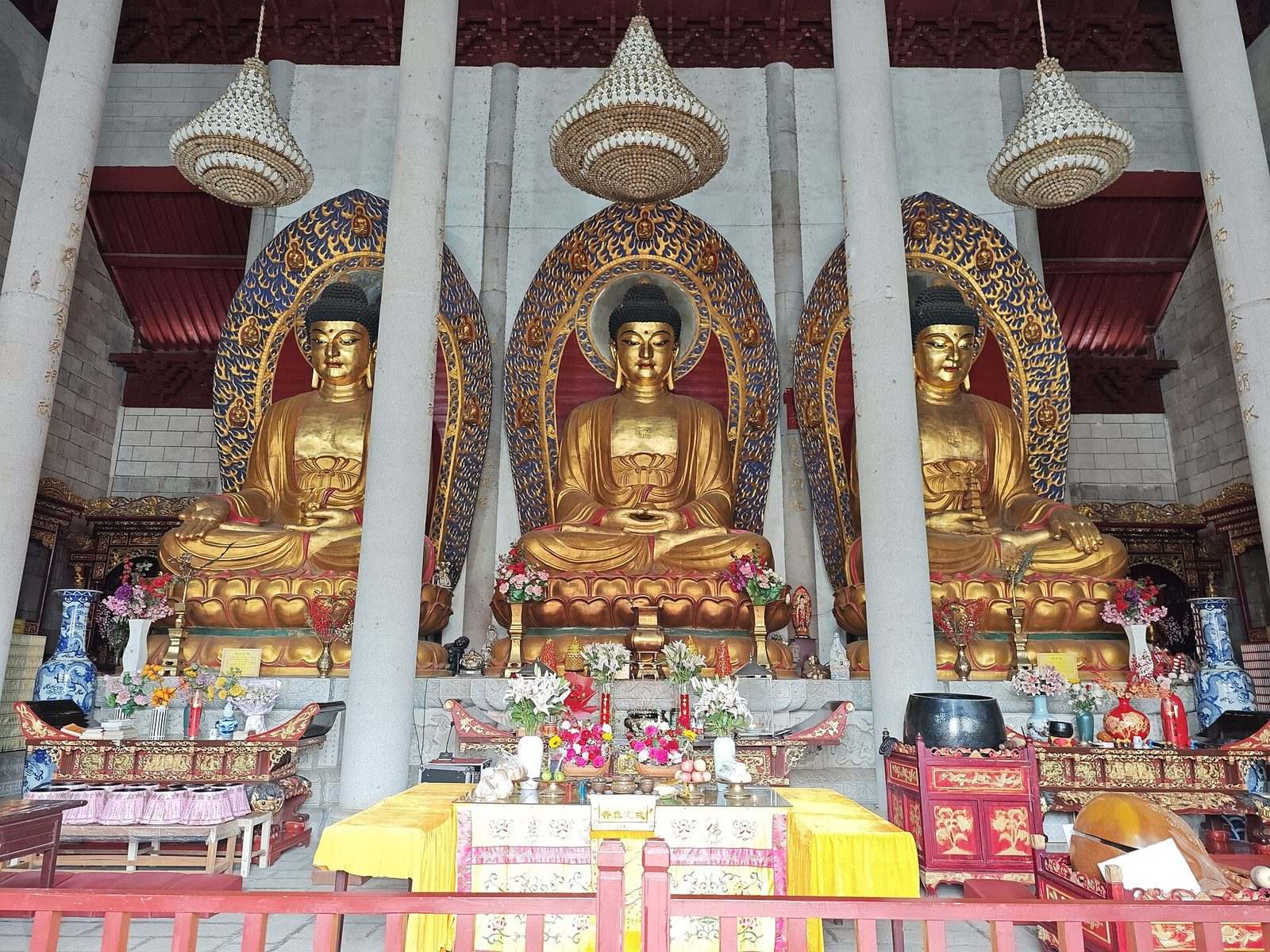
- 1the center buddha the middle seat almost always belongs to shakyamuni, the historical buddha. look for the bump on top of the head (the ushnisha, a sign of awakened wisdom), the dot between the brows, the long earlobes, and the flaming halo behind him studded with tiny buddhas.
- 2hands in the lap both hands rest palms-up in the lap: the meditation gesture (dhyana mudra). hand gestures, or mudras, are a whole visual language: hand touching the ground, hand raised to calm fear, fingers in a circle for teaching. then look down. every buddha here sits on a lotus, the flower that grows out of mud and comes up clean.
- 3the chest symbol yes, that's a swastika (卍, wan). it's an ancient symbol of good fortune that buddhism carried from india, thousands of years before the 20th century hijacked it. in china it reads as 'the buddha's heart' and you'll see it on temples, mooncakes and old window lattices.
- 4what they hold the side buddhas hold small objects: a tiny pagoda here, a little jar on the other side. props are the id badges. some halls show the 'three directions' (the medicine buddha of the east, shakyamuni, amitabha of the western pure land), others past, present and future buddhas. the sign by the altar settles it.
- 5the offering table fresh flowers, fruit, candles, incense, cups of water. buddhist offerings are vegetarian, so no meat on this table. you'll see roast pork at folk and ancestor shrines, but not in front of a buddha.
- 6the singing bowl that big black bowl on a cushion is a qing (磬), a bowl-shaped bell. monks strike it during chanting to mark the rhythm and the start and end of a section. please don't tap it, however tempting.
a daoist pavilion of eight sides 八卦亭 · 青羊宫
the eight trigrams pavilion at qingyang gong (青羊宫), chengdu's big daoist temple. legend says laozi told his disciple yin xi to come find him at the 'green goat' market in chengdu. the current pavilion was finished in the 1880s, and almost every part of it is a cosmology lesson.
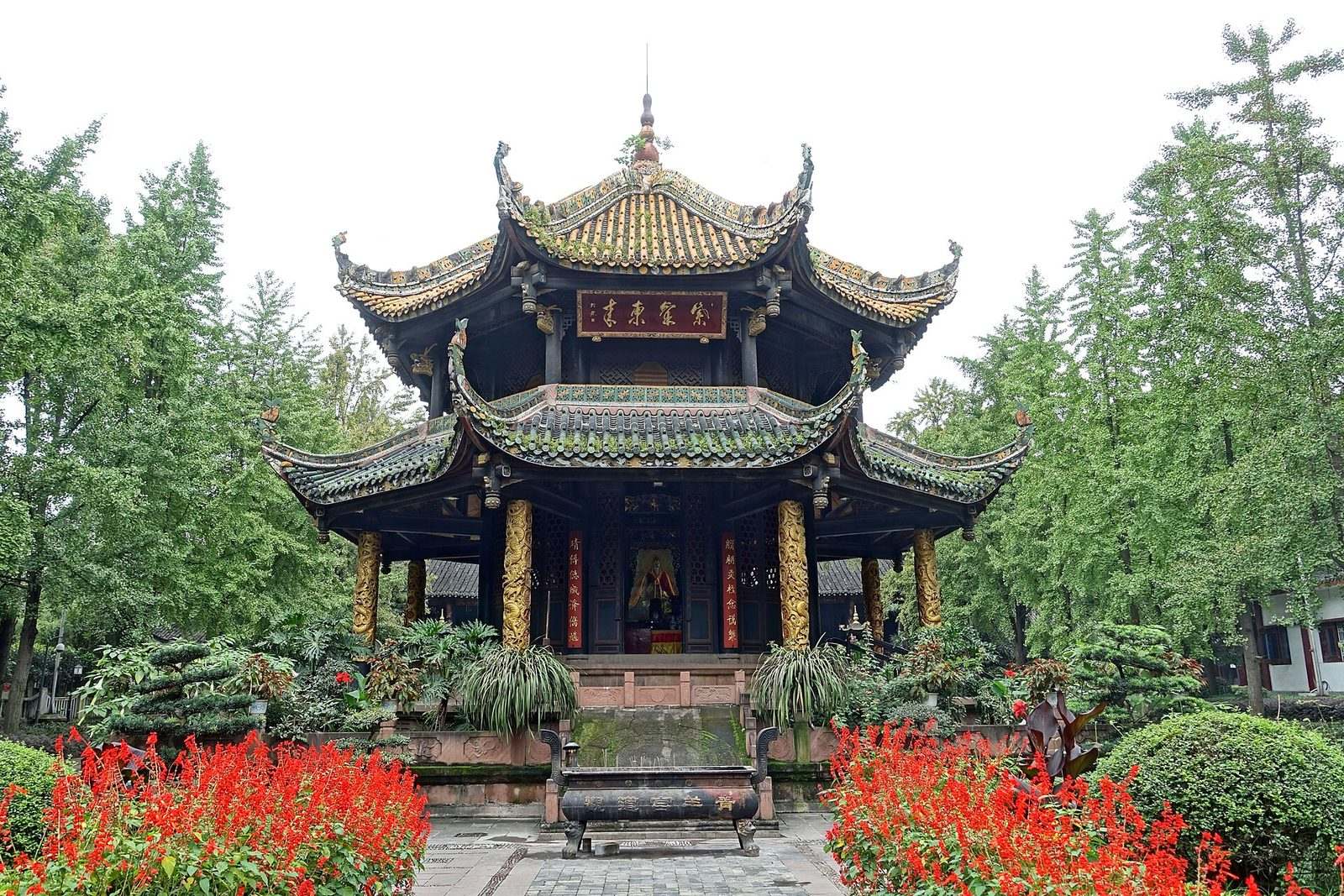
- 1count the sides eight sides, eight upturned corners, two rings of eaves. the pavilion is built on the bagua, the eight trigrams of the yijing (i ching) that daoists use to map heaven, earth, water, fire and everything between. an octagon is a strong daoist tell.
- 2the gourd on top the finial is a stack of gourds (hulu, 葫芦). in daoist art the gourd holds the elixir of immortality and is the go-to accessory of the immortals. a gourd on the roof is a strong hint you're not in a buddhist temple.
- 3'purple air from the east' 紫气东来, zi qi dong lai. the story goes that the gatekeeper yin xi saw purple vapor drifting in from the east and knew a sage was coming. it was laozi, who then wrote down the daodejing for him. it's now a stock phrase for good luck on its way.
- 4the dragon columns golden dragons wrap the stone pillars. the temple counts 81 dragons across the whole pavilion, one for each of laozi's 81 transformations in daoist legend (and the 81 chapters of the daodejing).
- 5who lives here through the door, framed by red couplets, is a figure of laozi, the sage daoism traces itself to. in daoist temples the main gods tend to be robed, bearded and seated like officials. compare that with the shaved heads and topknot curls of a buddha.
- 6the incense burner read the gold characters right to left: 青羊宫道观, qingyang gong daoguan. that one line holds both daoist name tags, gong (宫, palace) and guan (观, the classic word for a daoist temple). light incense here, outside, not in the hall.
the hall of great achievement 大成殿 · 北京孔庙
dacheng hall at beijing's confucius temple (孔庙), first built in 1302. no monks, no priests, no prayers for good luck. this was a state ritual space where the emperor's officials honored confucius as the greatest teacher. it borrows the palace's grammar more openly than any other kind of temple.
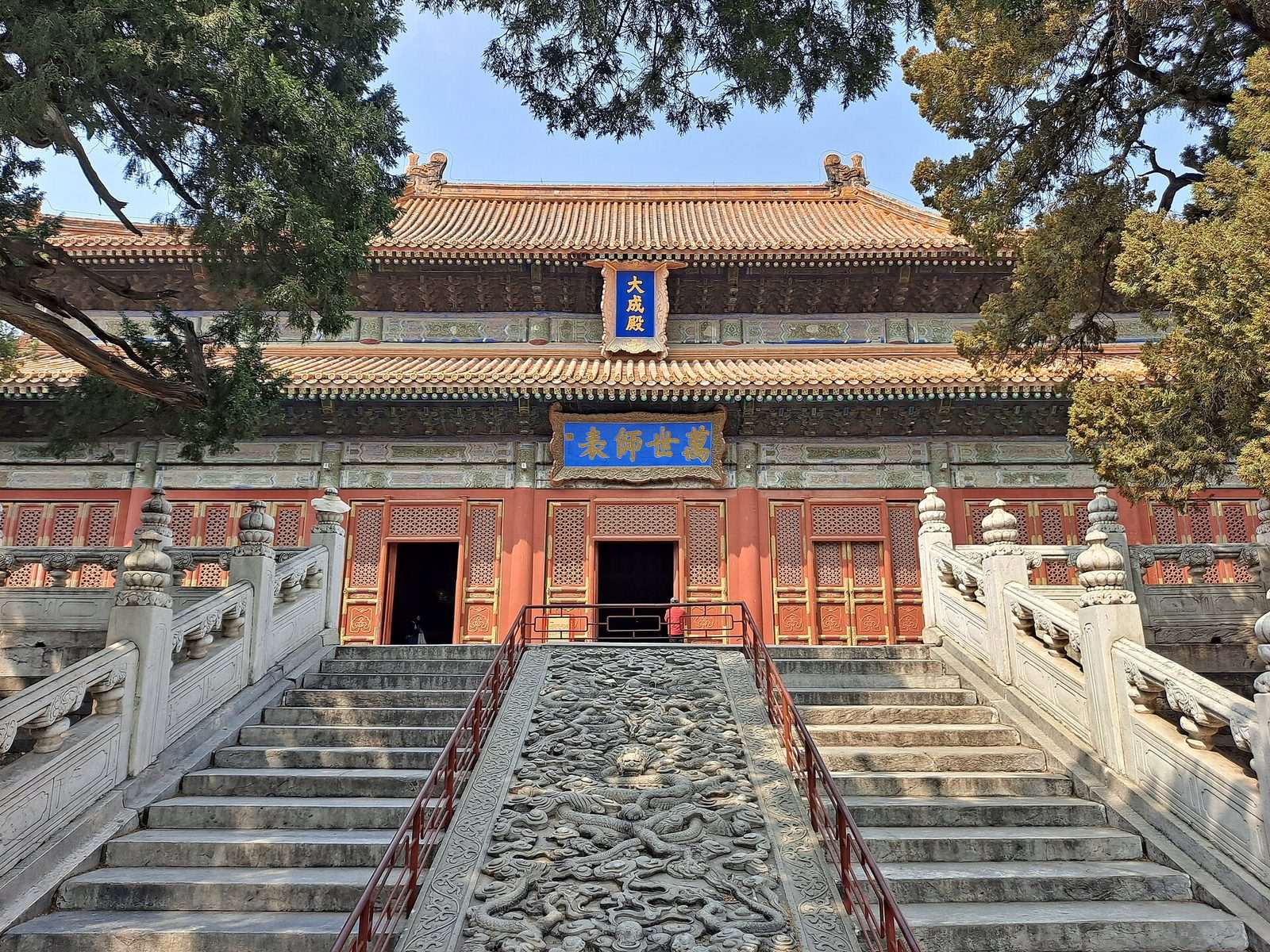
- 1the name board 大成殿, dacheng dian, 'hall of great achievement'. every confucian temple in china (and in korea, vietnam and taiwan) has one. if you see these three characters, you're in a wenmiao, a 'temple of culture'.
- 2'teacher for ten thousand generations' 万世师表, wanshi shibiao. the kangxi emperor wrote this in his own hand at confucius's home temple in qufu in 1684, then had it copied and sent to confucian temples across the empire. look for the same four characters wherever you find a confucius temple.
- 3the roof is the flex yellow glazed tiles plus a double-eaved hip roof is the highest rank in the imperial building code, the same roof type as the forbidden city's biggest halls. in 1906 the qing court raised confucius's rites to the top tier of state sacrifice and rebuilt this hall nine bays wide to match.
- 4what's inside (and what isn't) no giant golden statue. the altar holds a wooden spirit tablet with confucius's name and title, plus tablets for his leading disciples, the way you'd honor an ancestor. there's a portrait in there too these days. tablets over idols is the confucian tell.
- 5the dragon ramp the carved slab between the stairs is a yudao, an 'imperial way' of dragons in clouds. nobody walks on it. it marks the central axis, the line reserved for the emperor and the ritual itself.
- 6the white terrace the hall sits on a raised marble platform with carved balustrades, palace-style again. height means status. in the courtyard behind you (out of frame) stand 198 stone stelae carved with about 51,600 names of scholars who passed the top imperial exam.
switch tabs to go from a buddhist hall to the altar inside, then a daoist pavilion, then a confucian hall. now the cheat sheet.
buddhist, daoist or confucian? read the name first
the fastest tell is the last character on the gate.
| ends in | what it usually is | example |
|---|---|---|
| si 寺 | buddhist temple or monastery | lingyin si (hangzhou), shaolin si |
| an 庵 | small buddhist temple, often a nunnery | many neighborhood temples |
| yuan 院 | buddhist monastery (sometimes) | wenshu yuan (chengdu) |
| guan 观 | daoist temple | baiyun guan (beijing) |
| gong 宫 | big daoist temple (“palace”) | qingyang gong (chengdu) |
| wenmiao 文庙 / kongmiao 孔庙 | confucian temple | kong miao (qufu, beijing) |
the fun backstory on si: the word originally meant a government office. tradition says china’s first buddhist temple, white horse temple in luoyang (traditionally dated to 68 ad), got the name because the monks from india were first put up in an official guesthouse, and the name stuck to buddhist buildings forever.
caveats, because china loves a caveat:
- miao 庙 is loose. it can mean a confucian temple, a temple to a local god (a city god temple, a guandi miao for the war god guan yu, a mazu miao for the sea goddess) or just “temple” in general. a miao is often folk religion, which happily mixes all three traditions (more on that mix in what do chinese people believe).
- gong can fool you. beijing’s famous lama temple is yonghe gong, a “palace” because it really was one, the prince’s mansion of the future yongzheng emperor, before it was turned into a tibetan buddhist temple in 1744.
if you want the beliefs behind the buildings, read buddhism vs daoism vs confucianism first. this guide is about the architecture.
the layout: everything runs down one line
nearly every traditional chinese temple sits on a north-south central axis with the most important building at the back. you walk through the temple the way you’d walk through a palace: gate, courtyard, hall, courtyard, bigger hall.
in a buddhist temple:
- shanmen 山门, the mountain gate, often with three doorways. the name survives even in the middle of a city, because monasteries used to be up in the mountains.
- bell tower (east) and drum tower (west) on either side of the first courtyard: “morning bell, evening drum.”
- hall of heavenly kings (tianwang dian): four huge guardian kings, one for each direction, plus a big-bellied, laughing maitreya facing you as you walk in. tucked behind him, facing the main hall, is weituo, the armored protector of the dharma.
- the main hall (daxiong baodian): the buddhas. biggest roof, highest platform.
- often a guanyin hall, a sutra library or a meditation hall behind that.
daoist temples follow the same plan with different residents: a fierce red-faced guardian (wang lingguan) near the front, then halls for gods like the jade emperor, and usually the three pure ones (sanqing), daoism’s highest deities, toward the back. confucian temples swap in a lingxing gate, a semicircular “pan” pool with a little bridge (a symbol of the official school), a dacheng gate, and then dacheng hall. many also have a courtyard of stone stelae carried on the backs of giant stone turtles (bixi, a dragon’s son who loves heavy lifting).
why temples look like palaces
because, in a real sense, they are. when buddhism arrived in china around the 1st century ad, chinese builders didn’t invent new architecture for it. they used what they had: the timber-frame courtyard hall used for palaces, government offices and rich families’ homes. early indian-style temples were built around a central pagoda. over the centuries, and by the tang dynasty at the latest, the big buddha hall took the center and pagodas moved off to the side or out back.
it also happened literally. in the northern wei capital of luoyang (5th–6th century), aristocrats donated their mansions to become monasteries, residential halls and all. so a chinese temple hall really is built on the same blueprint as a throne room, with the buddha (or laozi, or confucius’s tablet) sitting where the emperor would.
daoism borrowed the same template and used court language openly. its top temples are gong, “palaces,” and its gods are dressed like officials in a celestial bureaucracy. confucian temples were state institutions, so they followed the imperial building code to the letter. walk the beijing central axis after a temple and you’ll see the family resemblance everywhere.
colors and roofs: the rank system
imperial china had sumptuary rules for buildings, and temples follow them:
- yellow glazed tiles were the emperor’s color. you see them on palaces and on temples with imperial standing or patronage (beijing’s confucius temple, the lama temple, the big state-favored monasteries). green tiles rank a step below. gray tiles are the everyday default.
- roof shape, from highest to lowest: double-eaved hip roof (four slopes, two layers of eaves) → double-eaved hip-and-gable → single-eaved versions → plain gable. if a temple hall has a double-eaved hip roof, it was a big deal.
- red walls and columns stand for good fortune and protection. the blue-green painted beams under the eaves are a palace-style decoration too.
- the parade of tiny roof beasts on the corner ridges is a rank badge: more figures, more important building. ten is the max, and only one building has it: the forbidden city’s hall of supreme harmony.
temple etiquette that actually matters
china’s temples are relaxed. people chat, kids run around, grandmas get their steps in. but a few things matter:
- step over the threshold, never on it. those high wooden sills at every doorway are meant to be stepped over. folk explanations vary (keeping out wandering spirits, respect for the temple), but everyone agrees: don’t stand on it.
- walk clockwise around stupas, pagodas and prayer wheels, keeping them on your right. this matters most at tibetan buddhist sites like the lama temple. (pagoda history fans: xi’an through the dynasties covers the two goose pagodas.)
- photos: courtyards and exteriors are almost always fine. inside halls, many temples post “no photography” signs, and the lama temple bans photos inside its halls. if there’s a sign, put the phone away. never pose with your back to a buddha.
- don’t touch the statues, offerings or ritual objects (yes, including the giant bowl bell). don’t point your feet at an altar if you sit down.
- dress: shoulders and knees covered is respectful, especially at active monasteries.
- incense: many big temples hand you a few sticks free at the gate or with your ticket. use them in the big burner outside the hall, three sticks is traditional, and don’t bring incense inside. ignore touts near the entrance pushing giant “lucky” sticks or fortune readings. that’s a classic tourist squeeze, and the temple doesn’t want you buying them.
- donations go in the merit boxes (gongde xiang). they’re optional. entry tickets are usually cheap, from free to around $3–10 at big-name temples.
where to practice reading
- beijing: lama temple (yonghe gong) for tibetan buddhist, then walk five minutes to the confucius temple and the imperial academy next door. white cloud temple (baiyun guan) for daoist. guangji temple, from the first tab, is a free working monastery in the west of the city. see our beijing guide and the beijing neighborhoods piece for where to base yourself.
- chengdu: wenshu monastery for buddhist (with one of the best teahouses in the city, see my teahouse afternoon), qingyang gong for daoist. they’re a short metro ride apart. more in the chengdu guide.
- hangzhou: lingyin si, one of china’s most famous chan (zen) monasteries, tucked into the hills with buddhas carved into the cliffs at feilai feng.
- qufu (shandong): confucius’s hometown, with the original confucius temple, family mansion and cemetery. an easy high-speed rail day trip from jinan, or a stop between beijing and shanghai.
the vibe check
you don’t need to know every deity to enjoy a chinese temple. you just need to read the signs: the last character of the name, the line of halls running north, the color of the roof, and who (or what) is sitting on the altar. a lotus and curls means buddha. a beard, a gourd and an octagon means daoist. a wooden tablet under yellow tiles means confucius, honored like the empire’s most important ancestor.
once you can read them, temple number seven stops being “another temple.” it becomes a building you can decode in the time it takes the person in front of you to light their incense.
the kit for this trip
heads up: some links above are affiliate links. if you book through them we earn a small commission at no extra cost to you — it keeps this guide free. more on that.