the three teachings
buddha, laozi, confucius: one venn
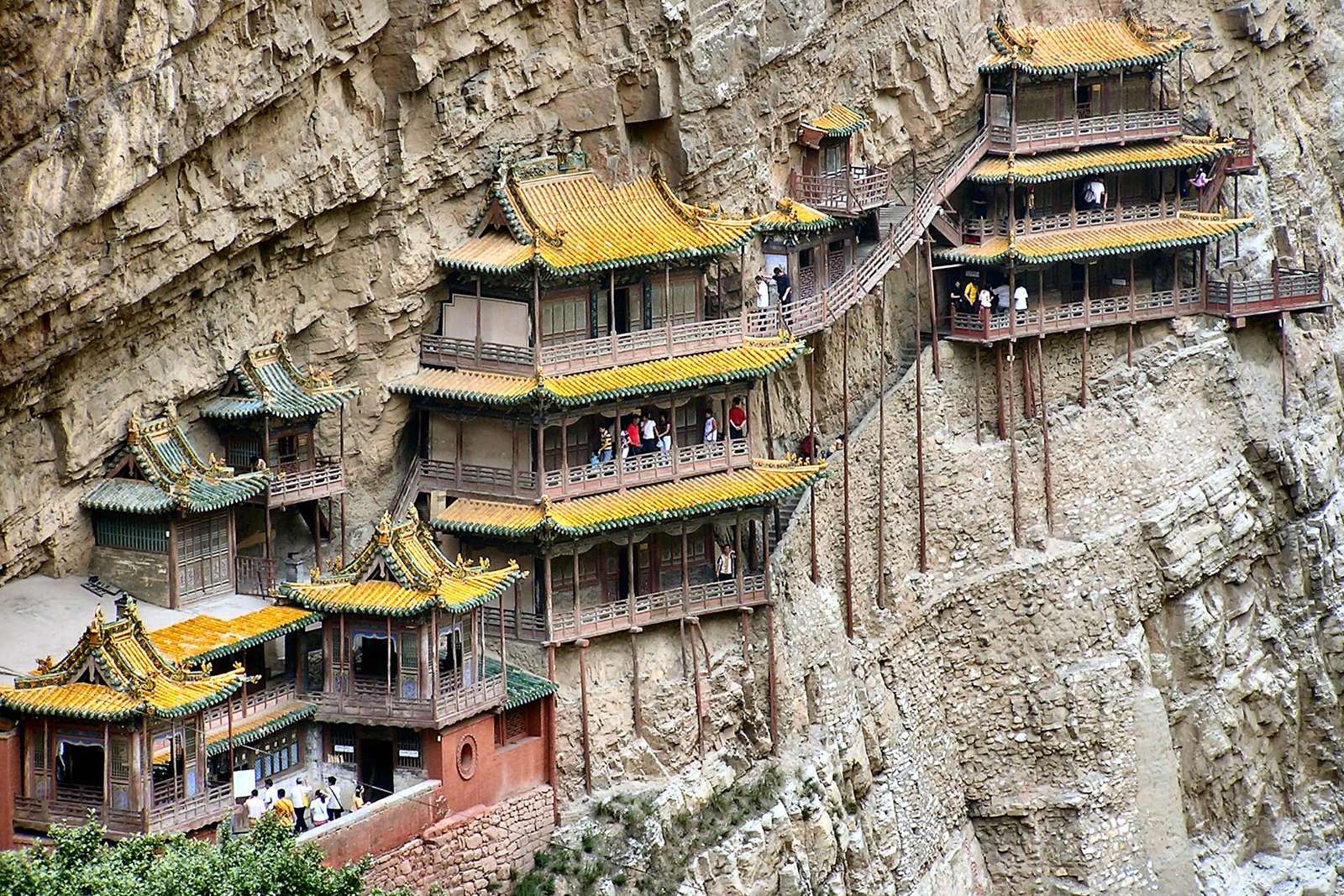
the hanging temple has all three in one hall lol
- confucianism (~5th c. bc) is about relationships, ritual and character. daoism (texts from ~4th c. bc, a religion from the 2nd c. ad) is about flowing with the dao. buddhism arrived from india around the 1st century ad.
- most people in china don't pick one. the old phrase is sanjiao heyi, 'the three teachings are one', and plenty of temples literally seat all three founders together.
- whether confucianism even counts as a religion is a real, unresolved scholarly debate.
- temple etiquette is easy: don't step on the threshold, don't point at or photograph statues inside halls where signs say no, dress modestly, and walk around altars clockwise.
there’s an old chinese saying that a person wears a confucian hat, daoist robes and buddhist sandals. it’s a joke about people who mix everything, and it’s also just… an accurate description of how religion in china has worked for about 1,500 years.
if you grew up somewhere where religions are clubs (you’re in one, you’re not in the others), china will scramble that instinct. you’ll walk into a buddhist temple and find a daoist god of wealth in a side hall (our how to read a chinese temple guide helps you tell whose hall is whose). you’ll see a family burn incense to guanyin in the morning and sweep their ancestors’ graves in the afternoon, and nobody thinks that’s a contradiction.
so instead of three separate essays, here’s a map of where the ideas actually live.
the three teachings, mapped
burning incense 烧香
the universal gesture: three sticks, a bow, a wish. you’ll see it at buddhist and daoist temples and at roadside shrines alike — the act matters more than whose altar it is.
ancestor veneration 祭祖
offerings, spirit money and grave-sweeping at qingming. confucian texts codified the rites; the belief that ancestors need feeding and can bless or haunt you is deep popular religion.
filial piety 孝
the core confucian virtue. buddhism, once criticized for pulling sons into celibate monasteries, answered with stories like mulian rescuing his mother from hell.
karma & rebirth 因果轮回
an indian idea that arrived with buddhism and became so common sense that it’s now just how people talk about luck and consequences.
qi, yin-yang & five phases 气 · 阴阳 · 五行
pre-dates both schools as a shared chinese cosmology. han-dynasty confucians like dong zhongshu built it into statecraft; daoists built it into body cultivation; tcm and fengshui run on it.
fengshui 风水
reading the flow of qi through land and buildings, for homes and especially graves. mostly a folk art practised by specialists — some of whom are daoist priests.
fortune sticks 求签
shake a cylinder until one numbered stick falls out, then match it to a printed poem. found at daoist and buddhist temples (guanyin’s sticks are famous) but it’s pure popular practice.
vegetarian fasting days 初一十五吃素
monks are vegetarian full-time; many lay people eat meat-free on the 1st and 15th of the lunar month, which is also when temples get busiest.
the kitchen god 灶君
watches the household all year, then reports to the jade emperor just before lunar new year — so families smear his lips with sweets. a folk god slotted into the daoist pantheon.
guanyin 观音
the bodhisattva avalokiteshvara, who became a beloved mother-figure in china. her image appears in daoist and folk temples too — everyone wants her on their side.
the jade emperor 玉皇大帝
ruler of heaven in popular imagination, at the top of a celestial bureaucracy that mirrors the imperial court. daoist theology ranks him below the three pure ones.
meditation 禅修 · 坐忘 · 静坐
all three sit still, for different reasons: chan meditation, daoist “sitting and forgetting” and inner alchemy, and the neo-confucian “quiet sitting” zhu xi recommended.
li (ritual propriety) 礼
the confucian idea that correct ritual and etiquette — bows, mourning periods, who sits where — actually shape character. the chinese banquet seating chart is li in action.
wu wei 无为
“non-action” or effortless action: don’t force things, go with the grain. the signature idea of the daodejing (confucius also used the phrase, but daoism owns it).
city god temples 城隍庙
each walled city had a divine magistrate, often a deified local official. today most city god temples are run by daoist associations — shanghai’s sits right by yu garden.
hungry ghost festival 中元节 · 盂兰盆
the 15th of the 7th lunar month: buddhists call it ullambana, daoists zhongyuan, and families just burn offerings for wandering spirits. one night, three names.
“three teachings” temples 三教合一
halls where the buddha, laozi and confucius sit side by side — like the sanjiao hall at the hanging temple in shanxi. the ultimate “why choose?”
buddhism 佛教
life is shot through with dukkha — unsatisfactoriness — driven by craving, and your actions (karma) carry you through cycles of rebirth. the way out is wisdom, ethics and meditation. chinese buddhism added a huge, compassionate cast of bodhisattvas, like guanyin, who delay their own liberation to help everyone else.
the goal → freedom from the cycle of rebirth (nirvana) — or, for many lay believers, rebirth in amitabha’s pure land.
feel it at: lingyin temple, hangzhou — a monastery founded in 328 ad, tucked among cliff carvings in the hills west of the lake
daoism 道教
the dao is the nameless “way” everything flows from. live in tune with it — simply, naturally, without forcing (wu wei). religious daoism adds a whole heavenly bureaucracy of gods, rituals by trained priests, and practices for health and long life.
the goal → harmony with the dao — long life, balance, and for adepts, becoming an immortal (xian).
feel it at: white cloud temple (baiyun guan), beijing — headquarters of the quanzhen school, with resident priests
confucianism 儒家 / 儒教
a good society is built from good relationships — parent and child, ruler and subject, friend and friend — each with its own duties. you become fully human through learning, ritual propriety (li) and humaneness (ren). whether it counts as a “religion” is one of the oldest debates in the field.
the goal → to become a junzi — a person of cultivated character — and leave a harmonious family and society behind you.
feel it at: the temple of confucius in qufu, shandong — his hometown, with the kong family mansion and cemetery next door
tap a practice to see why it sits where it sits. notice how crowded the middle gets, and how much lands in “folk,” the popular religion of gods, ghosts and ancestors that sits under and around all three.
confucianism: the ethics of showing up for people
confucius (kong qiu) lived from about 551 to 479 bc in the small state of lu, in today’s shandong. he wasn’t a prophet and didn’t claim to be. he was a teacher and would-be government adviser who mostly failed to get the jobs he wanted. his students collected his sayings into the analects, and those short, sometimes cranky lines ended up shaping east asian society more than almost any other book.
the big ideas: ren (humaneness), li (ritual propriety, the idea that doing the right ritual the right way actually shapes who you are) and xiao (filial piety). society works when every relationship, from parent and child to ruler and minister, is carried out well.
is it a religion? honestly, scholars still argue about it. confucius famously steered clear of talking about spirits (“we don’t yet understand life, how can we understand death?”). but there are confucian temples, state sacrifices to confucius went on for some two thousand years, and ancestor rites are deeply religious in feel. the chinese language even has two words for it, rujia (“the school of the ru”, a philosophy) and rujiao (“the teaching of the ru”, closer to a religion). the safest answer is “both, depending who’s asking.”
daoism: go with the grain
daoism starts with two strange, beautiful books. the daodejing, traditionally credited to laozi (a figure whose dates, and whose existence, historians can’t pin down), probably took shape around the 4th century bc. the zhuangzi is funnier and weirder, full of butterfly dreams and a cook who carves an ox without ever dulling his knife because he follows its natural joints.
the core idea is the dao, the nameless “way” everything flows from, and wu wei, effortless non-forcing action. water is soft, but it carves canyons.
then, in the 2nd century ad, zhang daoling founded the way of the celestial masters, and daoism became an organized religion too, with priests, scriptures, rituals and a huge heavenly bureaucracy of gods. the jade emperor, the city gods and the god of wealth all live here, alongside practices for health and long life. that’s the daoism you’ll meet in temples.
buddhism: the import that went native
buddhism came from india along the silk road. tradition says emperor ming of the han dreamed of a golden figure, sent envoys west, and in 68 ad founded the white horse temple in luoyang, named for the horse that carried the scriptures. it’s often called china’s first buddhist temple, and you can still visit it.
at first it was a hard sell. monks shaved their heads and stayed celibate, which looked like an attack on filial piety, since no sons means nobody to feed the ancestors. so chinese buddhism adapted. translators borrowed daoist vocabulary to explain foreign ideas. stories like mulian, a monk who goes to hell to rescue his mother, made buddhism look extremely filial. the bodhisattva avalokiteshvara slowly became guanyin, the gentle, female-presenting figure of mercy you’ll see everywhere.
the most famous fusion is chan, which japan later exported to the world as zen. it traces itself to the legendary indian monk bodhidharma, and to the 7th-century master huineng. its love of paradox and spontaneity, and its suspicion of scripture, owes a lot to zhuangzi. a lot of scholars describe chan as what happens when indian buddhism and chinese daoist sensibility have a kid.
the three teachings at court
for centuries, emperors staged formal debates between buddhists, daoists and confucians, and the rankings shifted with each dynasty. around the new year of 574, after one of these debates, emperor wu of the northern zhou ranked confucianism first, daoism second and buddhism last. that summer he went further and banned both buddhism and daoism, sending monks and priests back to lay life. the tang royal family claimed descent from laozi (surname li) and mostly favored daoism, though empress wu zetian backed buddhism, and in 845 emperor wuzong ran a huge suppression of buddhist monasteries.
then came the synthesis. neo-confucianism, above all zhu xi (1130–1200), absorbed buddhist and daoist metaphysics (principle, li 理, and material force, qi) into a revived confucianism. zhu xi even recommended “quiet sitting,” which looks a lot like meditation. his commentaries on the four books became the basis of the imperial exams from 1313 until the exams ended in 1905.
by the ming, the phrase sanjiao heyi, “the three teachings are one,” was a whole movement. lin zhao’en (1517–1598) founded an actual three-in-one religion, and temples started seating the buddha, laozi and confucius side by side. the hanging temple in shanxi (the cliffside one in the photo up top) has a three teachings hall that does exactly this.
how to behave in a buddhist temple
- step over the threshold, don’t step on it. those raised wooden sills at hall doors are meant to be stepped over.
- incense is optional. many big temples (like beijing’s lama temple) hand out free sticks with your ticket. three sticks, held at forehead height, a small bow, place them in the big burner outside, never inside the hall.
- don’t photograph statues inside halls if there’s a sign, and there often is. outside is usually fine.
- walk clockwise around stupas and altars, especially in tibetan buddhist temples.
- dress modestly-ish: shoulders and knees covered is respectful, though you’ll see plenty of tourists who didn’t get the memo.
- don’t touch monks or nuns, and don’t point your feet at a buddha if you sit down.
- the 1st and 15th of the lunar month are the busiest days. lovely energy, long incense queues. big holidays too — see chinese festivals through the year.
how to behave in a daoist temple
basically the same rules. daoist temples (guan 观 or gong 宫) are often a bit more relaxed and a bit more colorful. you may see priests with their hair in a topknot, which is how you tell them apart from shaved-head buddhist monks. fortune sticks (qiuqian) are common, and if you try it someone may offer to interpret your poem for a small fee. totally optional.
how to behave in a confucian temple
confucian temples (wenmiao or kongmiao) are the quietest of the three, more like a solemn academy than a place of daily prayer. there’s no clergy and usually not much incense. you’ll see stone tablets listing past exam graduates, old cypress trees, and in exam season, students tying red wishing cards near the main hall. bowing is nice, and nobody expects you to do more.
the big one is the temple of confucius in qufu, shandong, his hometown, a unesco site together with the kong family mansion and the cemetery where he’s buried. it’s an easy high-speed train hop from beijing or shanghai. check the train guide.
what this means when you visit
if you’re wondering what people actually believe, as opposed to what the textbooks say, we went digging through the survey data in what do chinese people actually believe?. spoiler: very few people call themselves religious, and lots of people burn incense.
temples in our city guides: beijing, xi’an (the big wild goose pagoda was built for xuanzang’s sutras, brought back from india), chengdu (wenshu monastery’s teahouse is elite) and shanghai (jade buddha temple, plus the city god temple by yu garden).
the vibe check
confucianism tells you how to be a good person among other people. daoism tells you how to stop forcing everything. buddhism tells you why you suffer and how to let go. china mostly decided you don’t have to choose. walk into any temple with that in mind, step over the threshold, and you’ll be more in tune with the place than half the tour groups.
the kit for this trip
heads up: some links above are affiliate links. if you book through them we earn a small commission at no extra cost to you — it keeps this guide free. more on that.